














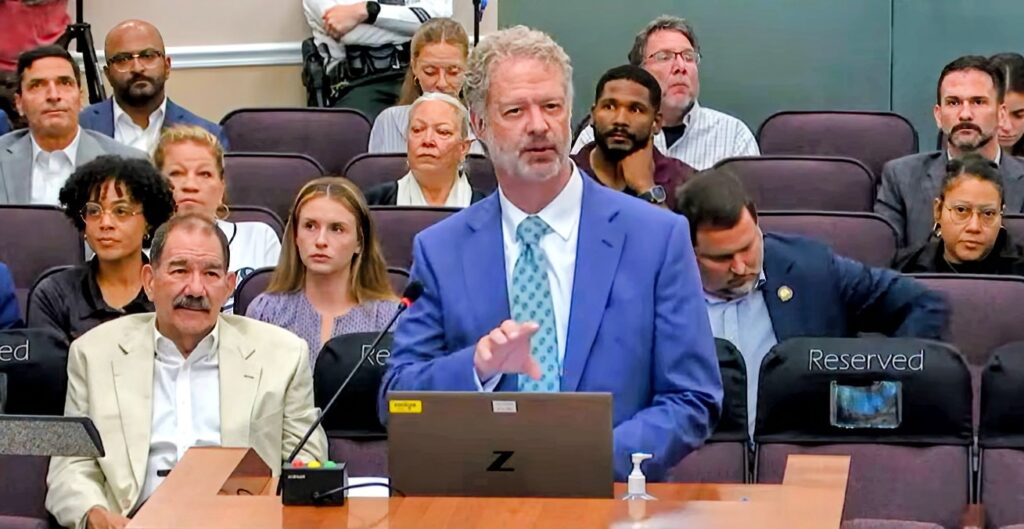
Deputy County Administrator Greg Horwedel (standing) called the Tampa Bay Rays’ timeline “very aggressive” when there is still “a lot of work that needs to be done.” Image: Screengrab.
Hillsborough County officials have roughly six weeks to approve a $2.3 billion stadium with the Tampa Bay Rays, despite a lack of information, assumption-based financial projections, and a funding shortfall.
A much-anticipated workshop on Thursday came less than a day after Rays CEO Ken Babby sent a letter to commissioners reiterating that the county and city must approve all agreements, which include over $1 billion in public funding, by June 1 to ensure the team can open a new ballpark by 2029. “Should this commitment ultimately not be achievable, we would have no choice but to evaluate alternatives,” he wrote.
Thursday’s meeting, however, began with County Administrator Bonnie Wise noting that “several significant issues remain unresolved.” Commission Chair Ken Hagan, a longtime proponent of the Rays moving across the bay, later acknowledged the team’s “sense of urgency to either reach an agreement or cut bait.”
“I would encourage staff to continue working on the remaining deal points internally and with the team, and make every effort possible to resolve the outstanding issues in advance of our May 6 meeting,” Hagan added. “And when I say that, I do recognize that this will require the team to make concessions on a number of issues.”
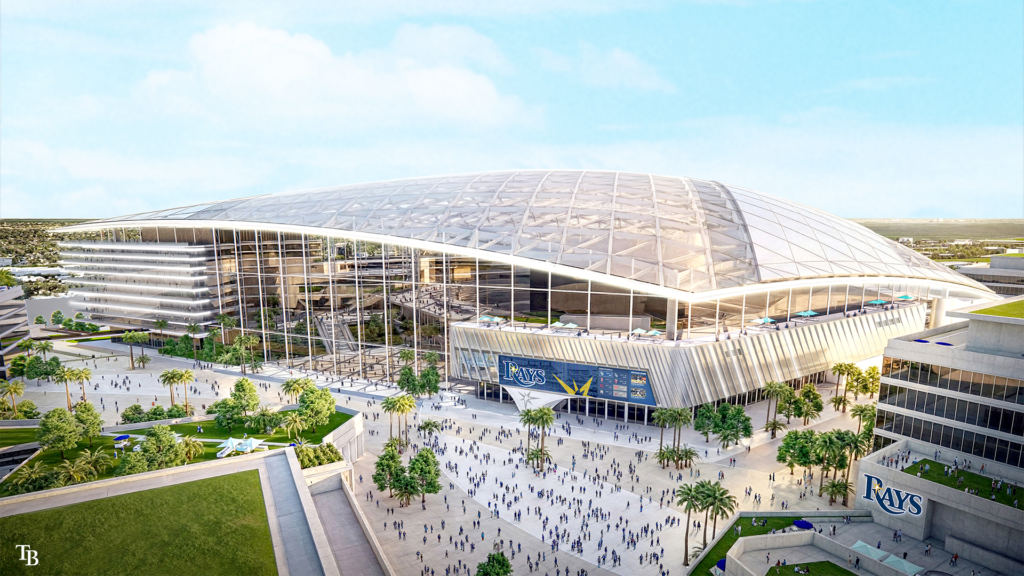
Hillsborough County officials want to value-engineer the proposed $2.3 billion ballpark to lower its cost. Rendering: Tampa Bay Rays.
Negotiations between the county and Rays have remained behind closed doors for months. That slightly changed on Thursday, though the meeting concluded with more questions than answers.
An independent firm found that a 31,000-seat stadium and, primarily, the surrounding mixed-use development at the Hillsborough College Dale Mabry campus, could generate a $63 billion economic impact over 30 years. Wise noted that AECOM reached that conclusion “based on the assumptions in their model.”
In total, the word “assumption” or its plural form was mentioned 14 times throughout the 97-minute meeting. For example, Commissioner Josh Wostal highlighted that AECOM’s tax collection projections considered only market-rate housing, even though the Rays have promised an untold number of affordable units, which would significantly reduce that value.
The team has yet to propose a community benefits package or even provide a detailed site plan. Wostal, an outspoken opponent of the current deal, said the county would not see a return on its investment for 30 years.
Deputy County Administrator Greg Horwedel said the Rays, who will ultimately contribute $1.235 billion to a new ballpark, “have indicated that they need the local public funding up front.” He also noted that the team has yet to verify its financial capacity to complete construction, and has not agreed to a reimbursement plan.
“This is a complex deal,” Horwedel said. “We’re not at the stage yet with staff where we feel comfortable with all the dollar amounts that are being proposed, and how those might impact the county budget.”
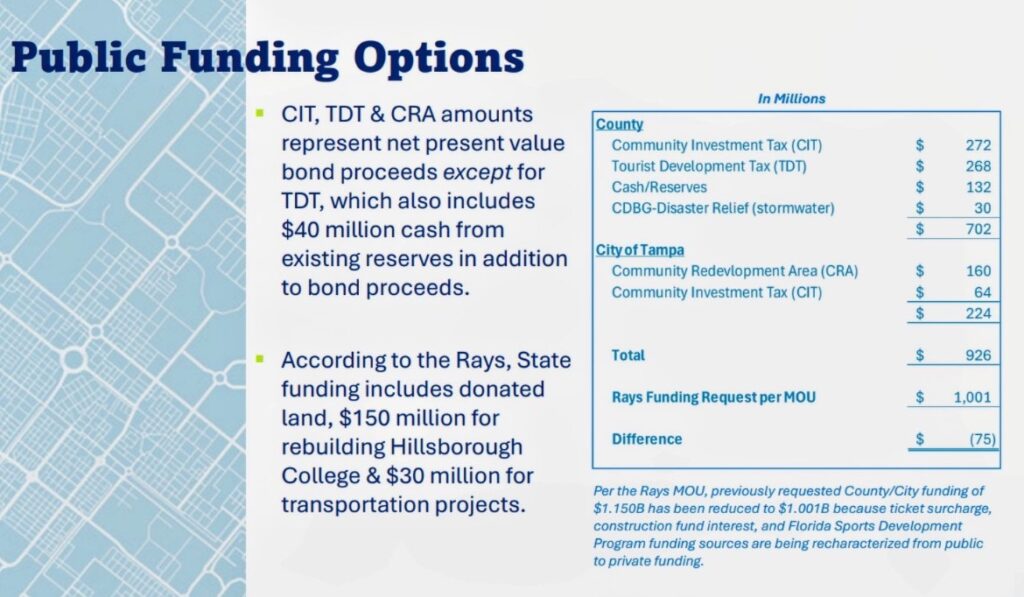
A list of public funding options that leave a $75 million deficit. Image: County documents.
Horwedel outlined a financing framework in which the county and city would contribute $702 million and $224 million, respectively, toward a new stadium. While the Rays have reduced their public funding request from $1.065 billion to $1.001 billion, there is still a $75 million gap.
Chief Financial Administrator Tom Fesler said the county “looked in the couch cushions to see where we could find some revenue.” He suggested using $132 million in cash reserves.
“You will find some of these funding options challenging to approve,” Fesler added. “We had limited ability to get to the … $750 million on the county side without looking at every available option possible.”
After presenting a potential spending plan, Horwedel highlighted 13 unresolved issues staff must address before a commission vote. Those include ownership of the stadium after the team’s lease expires, its effect on neighboring sports facilities, how to relocate Hillsborough’s busiest tax collector’s office, and value engineering the ballpark to reduce its cost.
A majority of commissioners expressed various levels of support for the project. All who spoke also aired concerns that must be addressed within weeks, according to the Rays.
Babby wrote that the team’s deadlines are “driven by practical constraints, not pressure tactics.” The Rays risk losing state funding if those timelines are not met, which would “render the deal economically infeasible.”
”Ultimately, we must decide what the value of Major League Baseball is to our community – from both the tangible benefits of economic impact to the intangible benefits of having pride in your hometown team,” Babby wrote. “However, we cannot proceed with an agreement that does not position the team for long-term success.”
Horwedel called the team’s timeline “very aggressive” as there is “still a lot of work that needs to be done.” Commissioner Harry Cohen said he would “love to be able to vote yes on this.”
“But I can only vote yes on it if I’m absolutely convinced that it’s the right thing for the community and taxpayers,” he added.
Commissioner Gwen Myers said the negotiating parties “need to come together to see how we can make the deal work” while fulfilling previous promises to residents. Hagan said final agreements will “look dramatically different than what’s been disseminated.”
Tampa City Council members will host a workshop on May 5. Hagan hopes to vote on an updated memorandum of understanding (MOU) with the Rays on May 6.
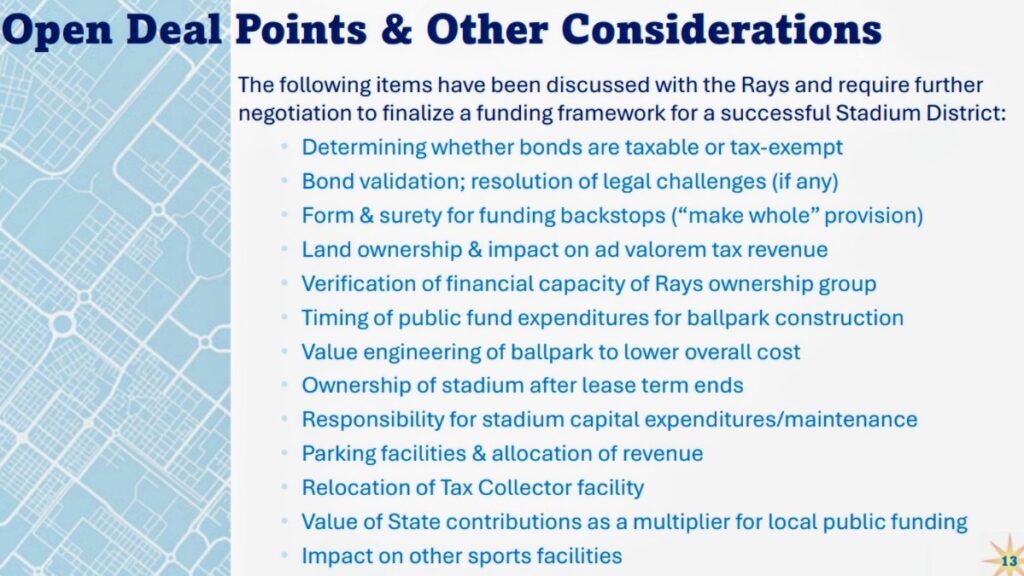
A list of 13 unresolved issues. Image: County documents.
Share Your News With Us
To share news with the Power Broker, email us at reachout@powerbrokermagazine.com. To sign up for our twice-weekly e-newsletter, visit www.powerbrokermagazine.com; and to join our online conversation, subscribe to our YouTube channel at Power Broker Media Group – YouTube.