

















South St. Petersburg neighborhoods have the highest Transportation Disadvantaged Program utilization rates in all of Pinellas County. Photo by Mark Parker.
Mayor Ken Welch’s administration has increased funding for a popular program that ensures low-income St. Petersburg residents can afford transportation.
The state-funded Transportation Disadvantaged Program, which launched in 2016, provides reduced-cost fares for qualified Pinellas County residents. Households that meet income requirements can purchase a non-consecutive 10-day bus pass for $5 or a 31-day unlimited pass for $11 through the program.
In 2023, the city entered into an agreement with the Pinellas Suncoast Transit Authority (PSTA) to eliminate any fees associated with the initiative. St. Petersburg’s annual subsidy enables its residents to ride for free by reimbursing PSTA for the cost.
Utilization has soared, and St. Petersburg’s subsidy has increased from $136,000 to $175,000 in two years to meet demand. The city council unanimously approved a $75,000 supplemental appropriation on March 26.
“Accessible public transit is a top priority for our community, and this increased funding ensures all eligible residents have the opportunity to participate in the program,” Welch said in a subsequent announcement. “With gas and other transportation-related costs continuing to rise, this program is more important now than ever.”
Residents must earn at or below 200% of the federal poverty threshold – $64,300 for a family of four – to qualify for the TD Program. They must also lack access to a car or rides from other members of their household.
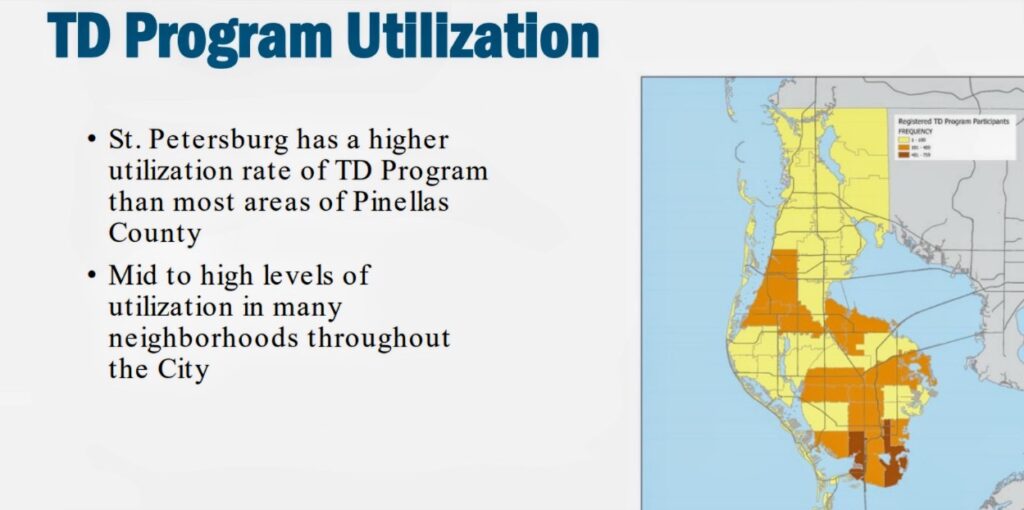
A map highlighting Transportation Disadvantaged Program utilization rates throughout Pinellas County, with darker color denoting the highest concentration of users.
PSTA data shows that 28% of all passengers in 2025 utilized a TD discount, second only to those who paid the standard fare (50.2%). Those demographics are followed by U-Pass holders (17.4%), passengers with bikes (3.8%), and those with wheelchairs (.6%).
City documents note that the program’s popularity has “grown steadily over the last two years” in St. Petersburg, which will now contribute $225,000 annually.“While TD bus passes cost significantly less than regular passes, the price would still be a barrier to some residents,” the administration wrote.
“This program affords the city a meaningful way to further reduce a financial burden for many residents who need public transit for some or all of their mobility needs.”
On average, the city’s subsidy supported 1,401 monthly passengers in 2025, a 24% increase over the previous year. St. Petersburg residents set a new utilization record in October.
South St. Petersburg neighborhoods have the highest TD Program utilization rates in all of Pinellas County. Welch thanked PSTA for its support and expressed pride in the city’s ongoing efforts to mitigate mobility challenges.
“We are so excited to expand this successful partnership, which over the last year has seen increases in both enrollment and overall ridership,” said Brad Miller, CEO of PSTA. “With these additional funds, we will be able to provide transportation to St. Petersburg citizens who need it most, without any direct impact on those citizens’ wallets.”
For program application information, visit the website here.
Share Your News with Us
To share news with the Power Broker, connect with reachout@powerbrokermagazine.com. To sign up for our twice-weekly e-newsletter, visit www.powerbrokermagazine.com; and to join our online conversation, subscribe to our YouTube channel at Power Broker Media Group – YouTube.