
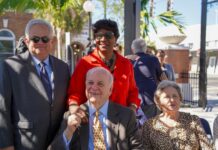

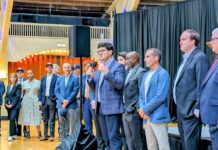










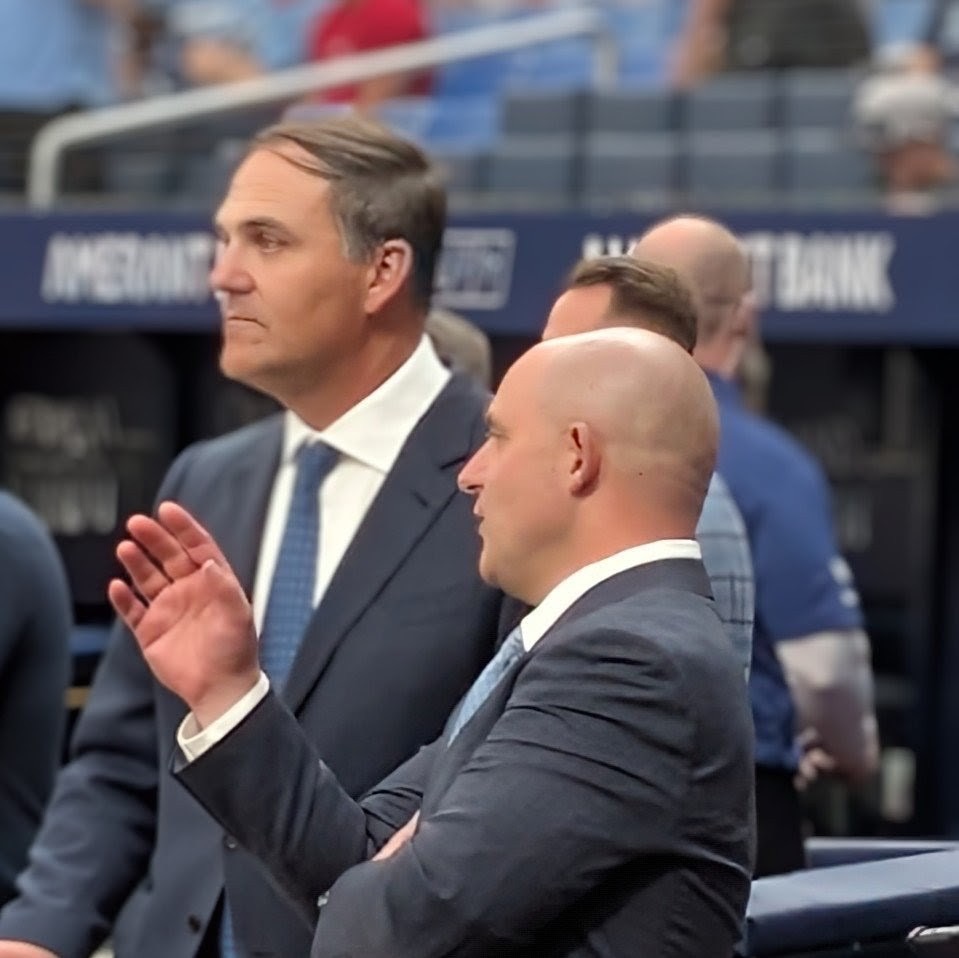
Tampa Bay Rays principal owner Patrick Zalupski and CEO Ken Babby at the team’s 2026 home opener in St. Petersburg. The team’s lease at Tropicana Field terminates following the 2028 season. Photo by Mark Parker.
A proposed Tampa Bay Rays stadium financing deal includes $1.065 billion in public funding and a self-imposed deadline of June 1, according to a draft memorandum of understanding (MOU).
Hillsborough County, which would contribute $750 million, received the document on Thursday. The Rays also seek $251 million from the City of Tampa and an additional $64 million from other public funding sources, including a federal disaster relief grant.
While the Rays will contribute $1.235 billion and cover all cost overruns, the total highlighted in the draft, obtained by Power Broker Magazine, is $465 million more than what the team previously requested from Pinellas County and St. Petersburg. Rays CEO Ken Babby expressed gratitude for the collaborative efforts of the parties listed in the 16-page document: Hillsborough County, Tampa, and the Tampa Sports Authority.
“This Memorandum of Understanding marks an important step forward and reflects a responsible public-private partnership that can be achieved through open communication and a commitment to getting this right for the community,” Babby said in a prepared statement.
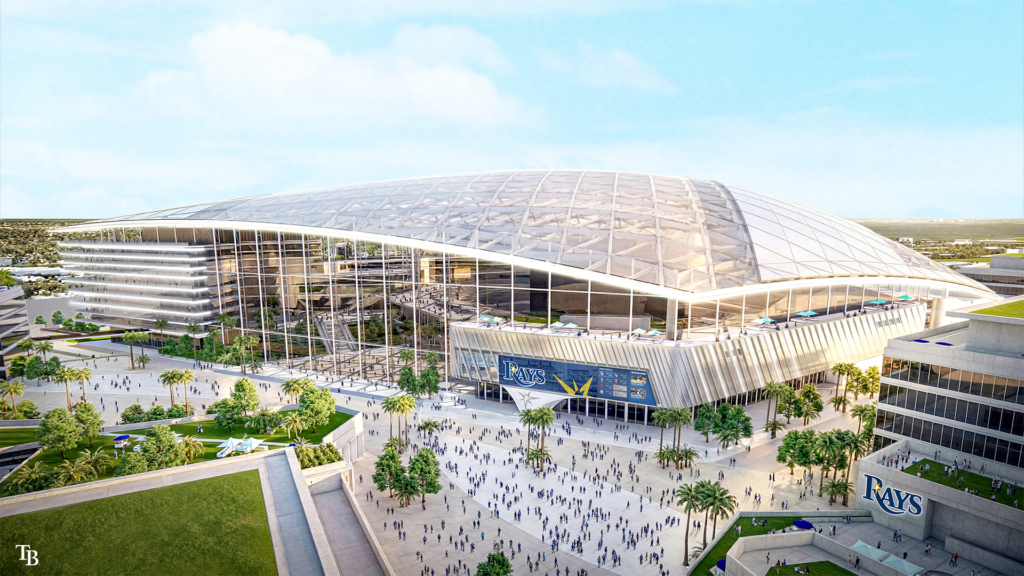
A rendering of the $2.3 billion ballpark. Image: Tampa Bay Rays.
Not so fast
The MOU provides the first financing framework for a $2.3 billion stadium at Hillsborough College’s Dale Mabry Campus since negotiations with the county began in early February. It also lacks critical details, including the amount of funding the team would receive from local tourist development taxes, the half-cent Community Investment Tax, and the Drew Park Community Redevelopment Area (CRA).
“The Parties need to finalize the (funding) sources and uses, which will be completed and agreed upon prior to execution of this Agreement,” states the document.
In addition, County Attorney Julia Mandell, in an email to commissioners, wrote that “this document is purely the work product of the Rays’ organization; it has not been reviewed or analyzed by any of the government entities … Therefore, none of the governmental entities, including the county administration, have provided any comments to the Rays organization on this document.”
Mandell added that none of the governmental stakeholders have “discussed the contents of this document with each other.” Time is of the essence, at least for the Rays.
The MOU states that those parties “shall work together to finalize and approve” project agreements by June 1 to “maintain a schedule that enables timely commencement and completion of the new stadium project by the 2029 Opening Day target date.”
Commissioner Josh Wostal took issue with multiple aspects of the proposed MOU. He was particularly concerned with a clause that states the county and city, if unable to meet funding contributions, “shall use best efforts” to secure alternative financing, “including, without limitation, state appropriations, infrastructure grants, or other municipal financing mechanisms, such as Capital Improvement Project funds.”
“It’s riddled with so many poison pills that I believe it’s an intentional attempt to kill the deal,” Wostal said. “And that no elected official could reasonably vote on what was proposed.”
The MOU also states that the county will use U.S. Department of Housing and Urban Development (HUD) disaster relief funding for infrastructure upgrades at the stadium site. Area stakeholders can, however, use the ballpark during declared emergencies.
“I told them from the beginning that they’re out of their minds if they ask for our Hurricane Milton funds for families whose lives got devastated, and we haven’t even been able to provide them relief yet,” Wostal said. “And they want us to fix their stormwater issues instead of people’s homes.”
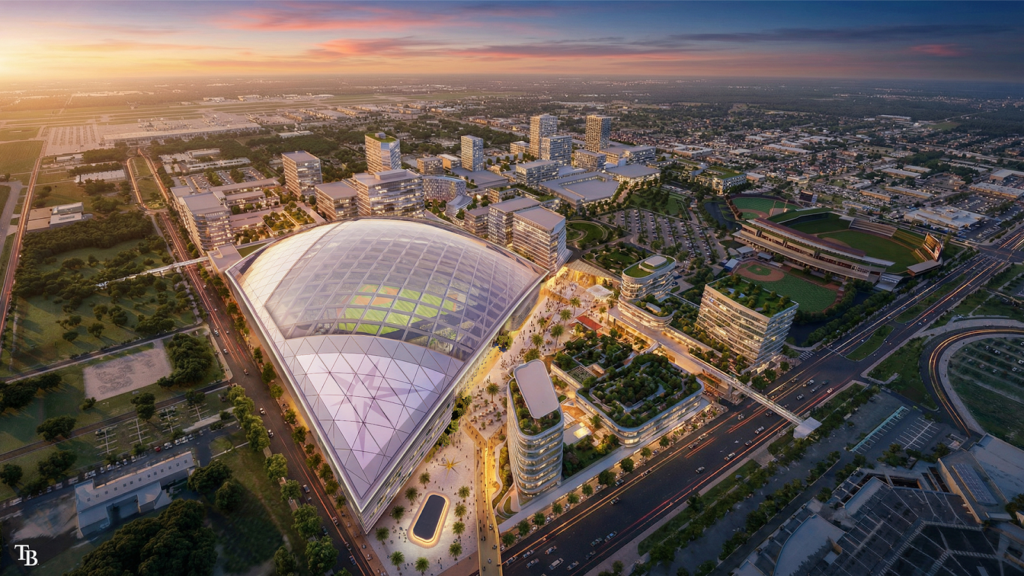
An aerial view of the stadium and surrounding $8 billion mixed-use district. Image: Tampa Bay Rays.
The Rays also want 85% of all CRA revenues to fund stadium capital expenditures rather than area improvements. Although the redevelopment area is scheduled to terminate in 2034, the MOU proposes an extension until 2056.
A stadium lease with the county would span 35 years, with the option for up to 15 years in renewals. The Rays will pay $10 annually.
Benefits
The Rays will cover all stadium maintenance, capital improvement, repair, and insurance costs. Ownership will agree to a non-relocation agreement.
Stakeholders will establish a community benefits package “that will address, among other things, local hiring goals, living wage commitments, community access, youth engagement, neighborhood enhancements, and direct community investments,” states the MOU.
An overview released by the Rays calls the undefined community benefits agreement the “largest in city and county history.” It adds that all parties have agreed to a “do no harm approach as it relates to longstanding public priorities,” particularly police, fire, and emergency management services.
The Rays reiterated that the ballpark ($10.4 billion) and the privately funded, $8 billion surrounding mixed-use district ($23.6 billion) will generate a $34 billion direct economic impact over 30 years. The team also expects the project to foster 11,900 permanent and 40,000 “full-time equivalent” jobs.
Commissioners will discuss the draft MOU at a workshop on April 14. A vote could come on May 6, and Babby said the team looks forward to working with stakeholders “as we refine the plan and move the process ahead.”
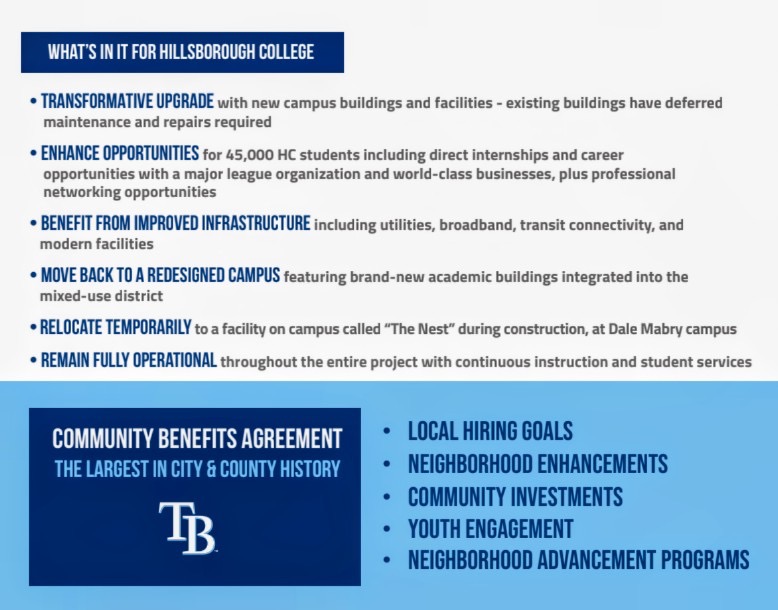
A graphic highlighting purported project benefits for Hillsborough College and the community. Image: Screengrab.
Share Your News With Us
To share news with the Power Broker, email us at reachout@powerbrokermagazine.com. To sign up for our twice-weekly e-newsletter, visit www.powerbrokermagazine.com; and to join our online conversation, subscribe to our YouTube channel at Power Broker Media Group – YouTube.