















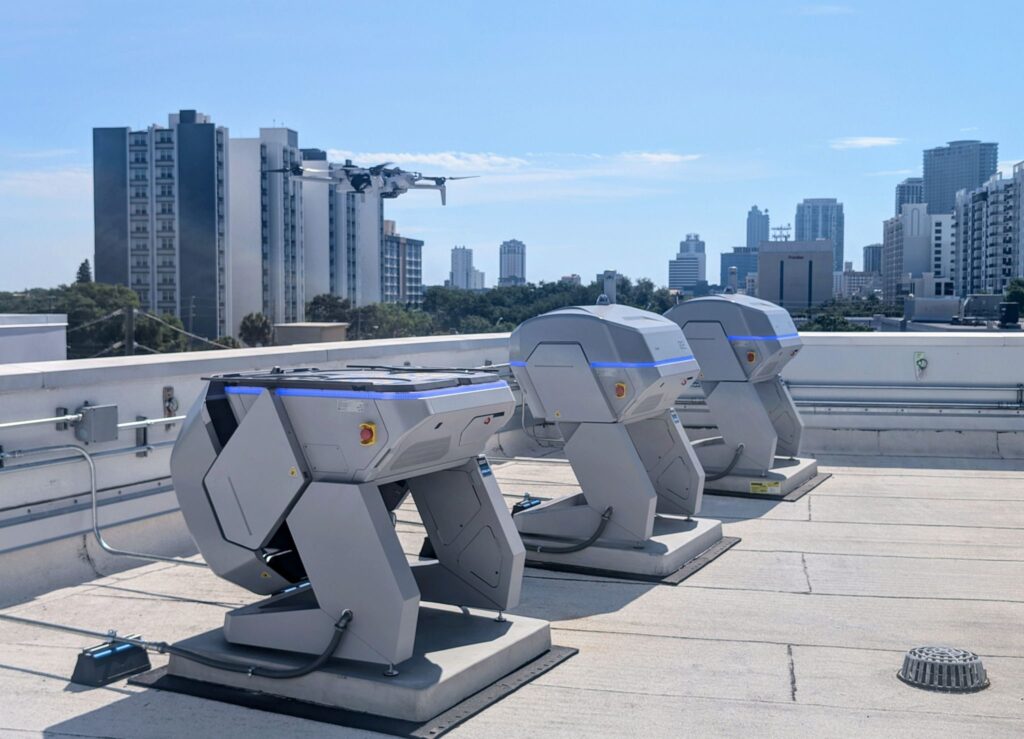
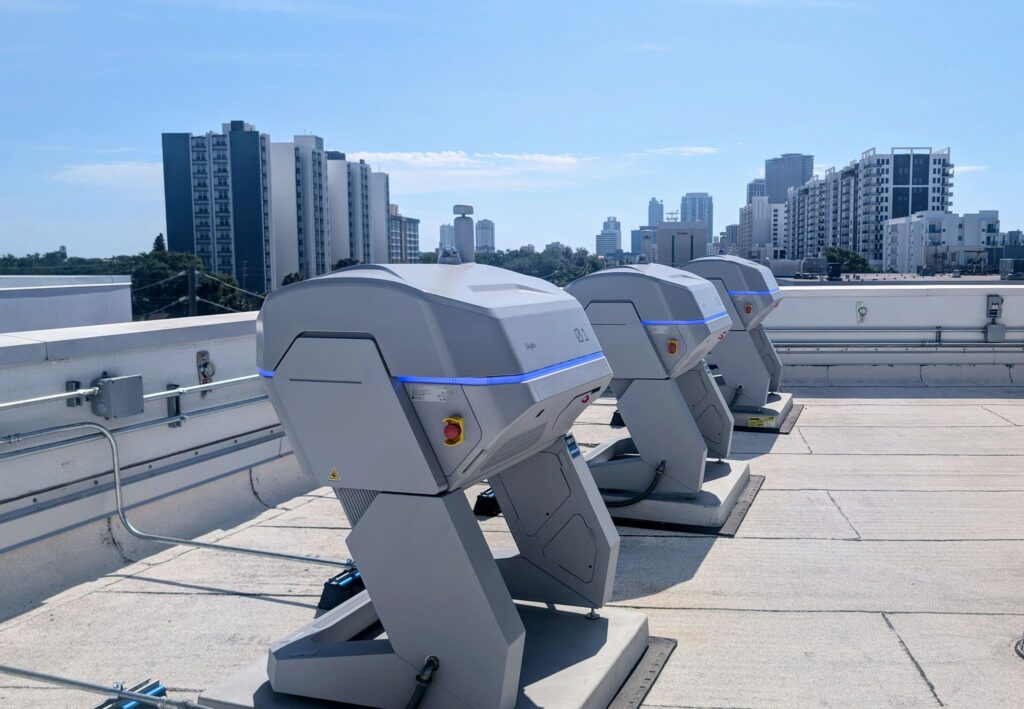
A Drone Hive atop the St. Petersburg Police Department’s headquarters launches one of three remotely operated aircraft that now respond to calls for assistance in real-time. All photos by Mark Parker.
Police Chief Anthony Holloway has a message for would-be criminals and residents in distress: The agency’s eyes in the sky are watching over St. Petersburg.
Holloway highlighted the St. Petersburg Police Department’s ongoing, high-altitude evolution on Wednesday. Officers now have a rooftop Drone Hive at their disposal, which allows them to use cutting-edge technology as additional first responders.
The three drones, controlled by pilots inside SPPD’s new Real Time Intelligence Center (RTIC), can provide quicker response times for high-priority calls. On-board cameras and thermal imaging can help officers locate suspects, missing children, endangered adults, and alert them to officers who need additional assistance.
“I want people to know that when you commit a crime here in St. Pete, you may not see us, but the drone sees you, and we are on our way, ” Holloway said. “We are now making the city safer. We’ve got a new tool in our toolbox, thanks to the mayor and city council.”
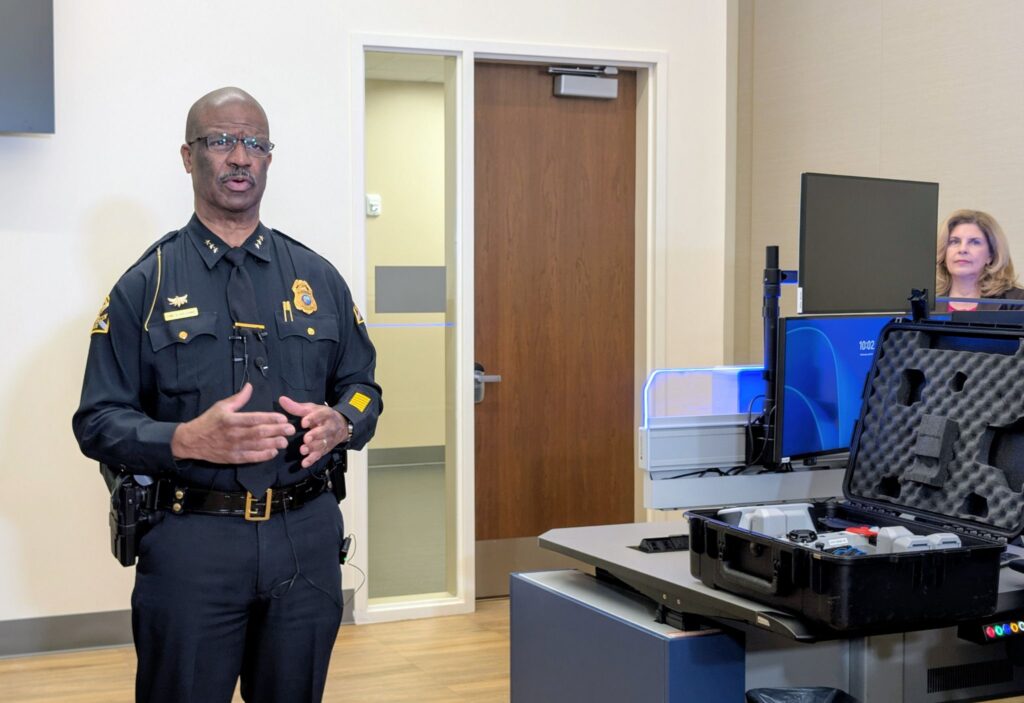
Police Chief Anthony Holloway inside the new Real Time Intelligence Center at the St. Petersburg Police Department’s headquarters.
The department began using drones in 2019 to assist with SWAT operations and narcotics raids. Officers subsequently realized the technology’s usefulness in fatal traffic accident investigations.
Holloway noted that in 2024, in the aftermath of Hurricanes Helene and Milton, city officials “came up with a great idea” for the remotely piloted aircraft: Storm damage reconnaissance. He said the SPPD then established a “drone as a first responder” initiative in response to Mayor Ken Welch’s missives to innovate.
The department now has 11 drones and 37 pilots, who must first receive Federal Aviation Authority certification before completing an internal training program. “The drones are not here to replace the officers on the streets,” Holloway emphasized.
“The drones are here as a tool so we can get to the scenes quicker, and we can give them more information so they can arrive safer.”
Officers initially stowed the drones, which each cost approximately $20,000, in the trunks of patrol cars. The first Hive drone, remotely operated by pilots within the RTIC, launched from the rooftop of SPPD headquarters earlier this year.
Sgt. Robert Long, supervisor of the RTIC, said a new technologically advanced platform allows officers to access several hundred public-facing cameras throughout the city. Those are all in “areas where there’s no expectation of privacy” to avoid any constitutional conflicts.
Officers in the RTIC pull up live camera feeds as calls for assistance are unfolding. They also launch the Hive drones and provide additional information from both systems, including whether a suspect is armed or fleeing, to responding colleagues in real-time.
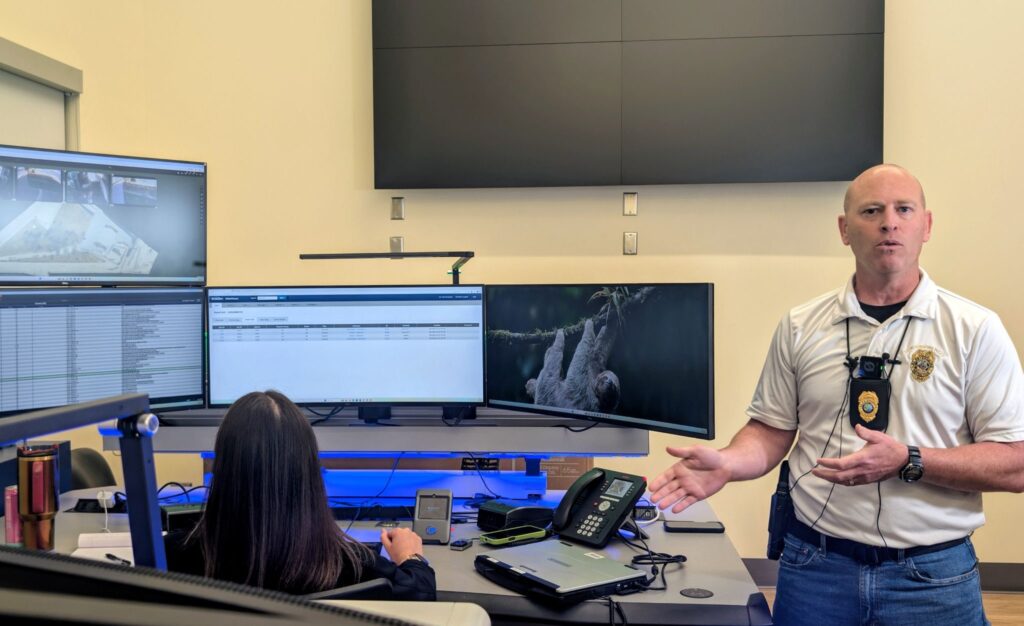
Sgt. Robert Long(right) motions toward an officer who is viewing a live feed from a camera at the St. Pete Pier.
The Hive features three drones. Each boasts a three-mile flight radius, can stay in the air for 35 minutes, has a top speed of 46 mph, and has a maximum altitude of 400 feet. Up to four easily interchangeable batteries allow for redeployment.
RTIC pilots can now remotely control drones deployed from patrol cars. Long said that enables officers on-scene to focus on police work.
Long also noted that three civilian analysts work behind the scenes, primarily with detectives, “to provide all sorts of efficiencies with things like patterns, suspect identification, and any kind of data collection and review.” In addition, the program provides a significant boost to evidence location and preservation efforts.
“It’s radically improving efficiency and safety,” Long added. “It’s had an immediate impact.”
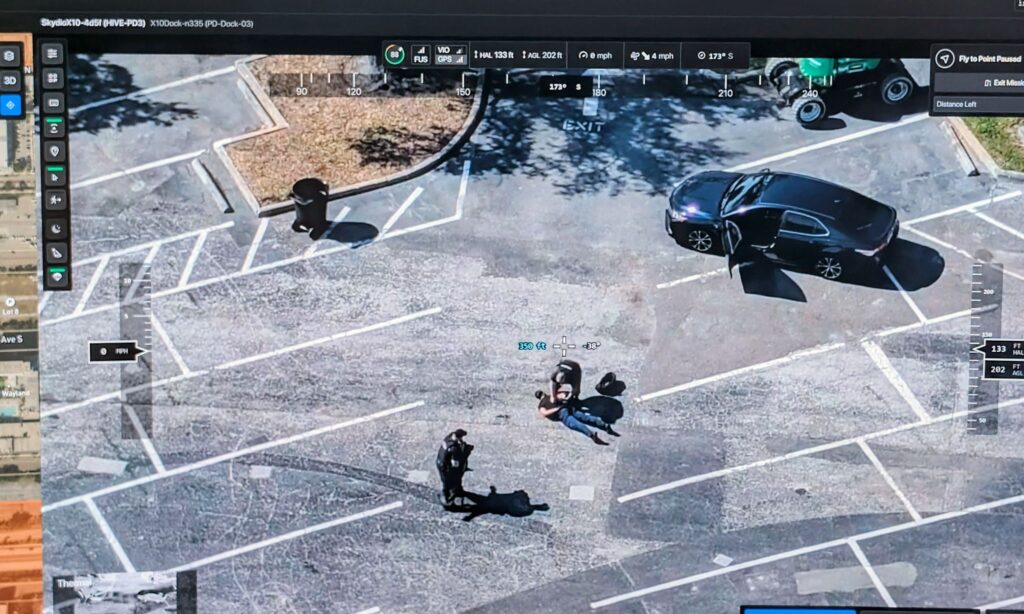
A view of a camera feed from a Hive drone after it intercepted a staged auto theft at Tropicana Field.
Including training and 863 service calls, the department has completed 2,223 total flights over the past 13 months. Those numbers will soon increase exponentially.
Long said the SPPD will strategically position four additional Hives with a total of 12 drones throughout St. Petersburg over the next two years. “The idea is to provide as much coverage citywide as possible.”
While some of the system’s software utilizes artificial intelligence (AI), Long said the drones cannot fly autonomously. Holloway said the department is also legally prohibited from using the airborne cameras for surveillance unless a crime has already been committed.
The department will explore potential workforce development partnerships with local schools and organizations “down the road,” Holloway said. For now, he and his officers are focused on maximizing the program’s impact while remaining within their allotted budget.
Holloway said he could never have imagined, when his law enforcement career began 40 years ago, that Drone Hives and a Real Time Intelligence Center would one day be used to enhance public safety. “Now you’re talking about a huge game changer,” he said.
Share Your News With Us
To share news with the Power Broker, email us at reachout@powerbrokermagazine.com. To sign up for our twice-weekly e-newsletter, visit www.powerbrokermagazine.com; and to join our online conversation, subscribe to our YouTube channel at Power Broker Media Group – YouTube.
More Photos
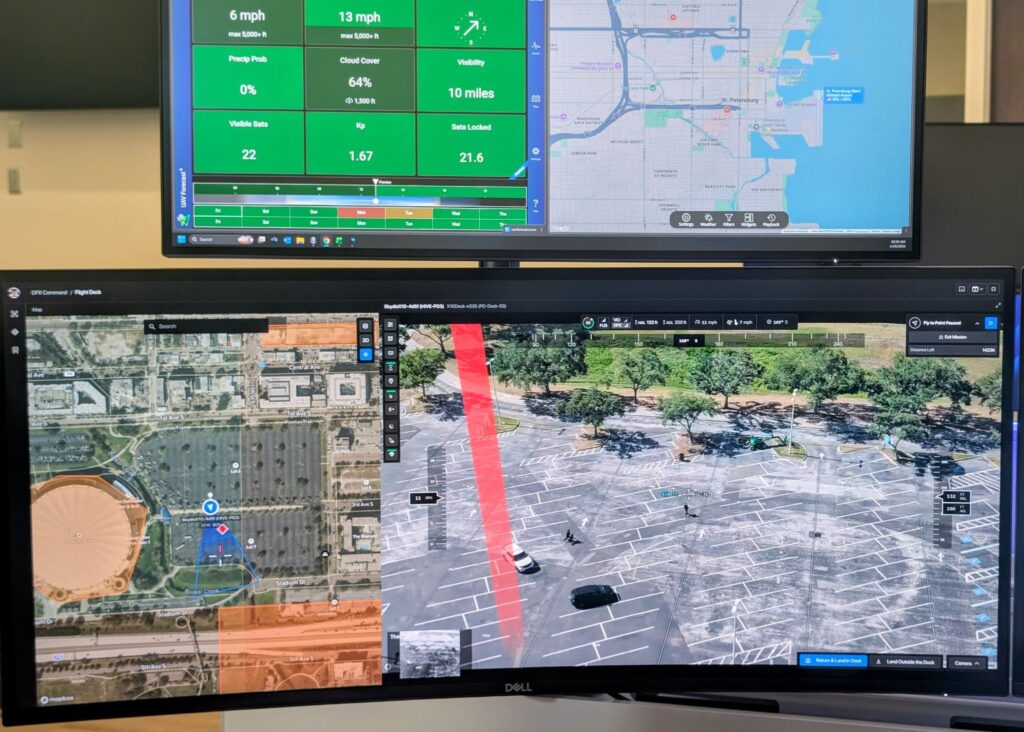
What officers in the Real Time Intelligence Center see when operating a Hive drone.
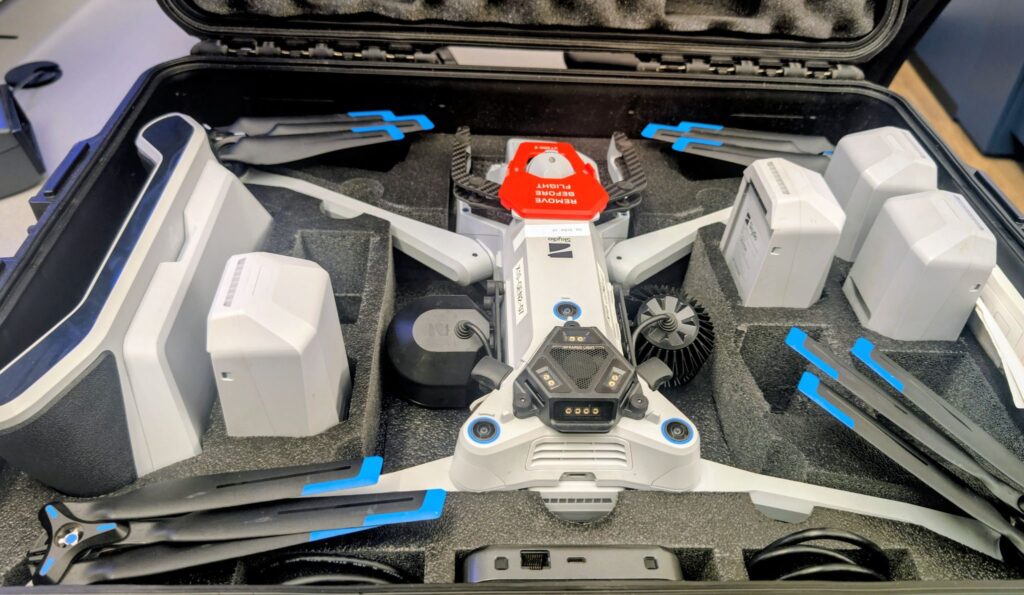
Officers carry eight other drones in the trunks of their patrol cars for remote deployment.
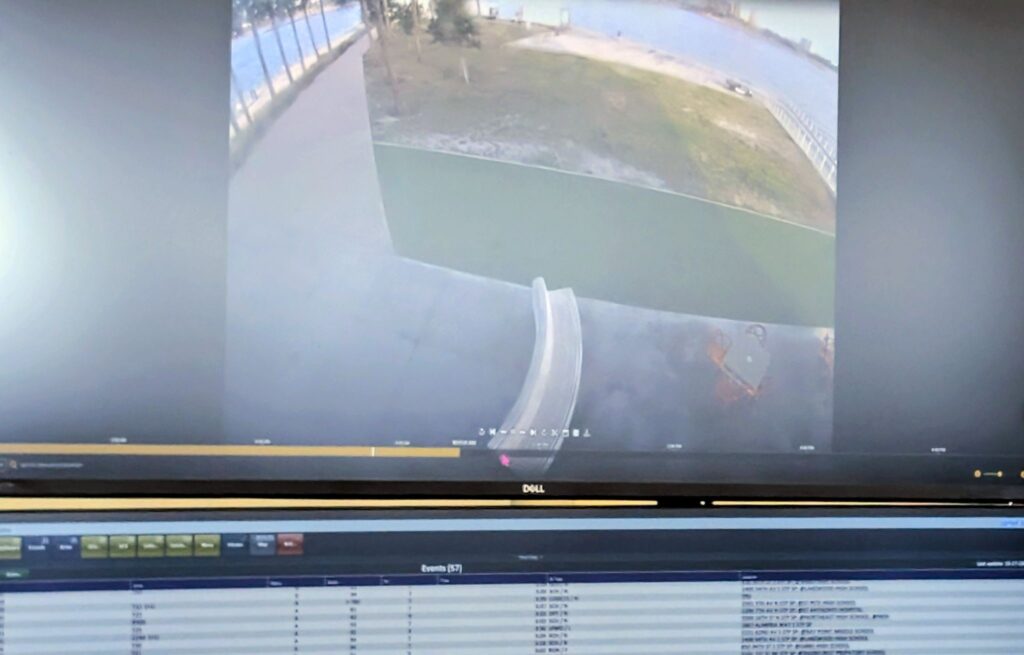
A close-up view of a camera feed from the St. Pete Pier
The Drone Hive opens and deploys its cargo in approximately 30 seconds.