
















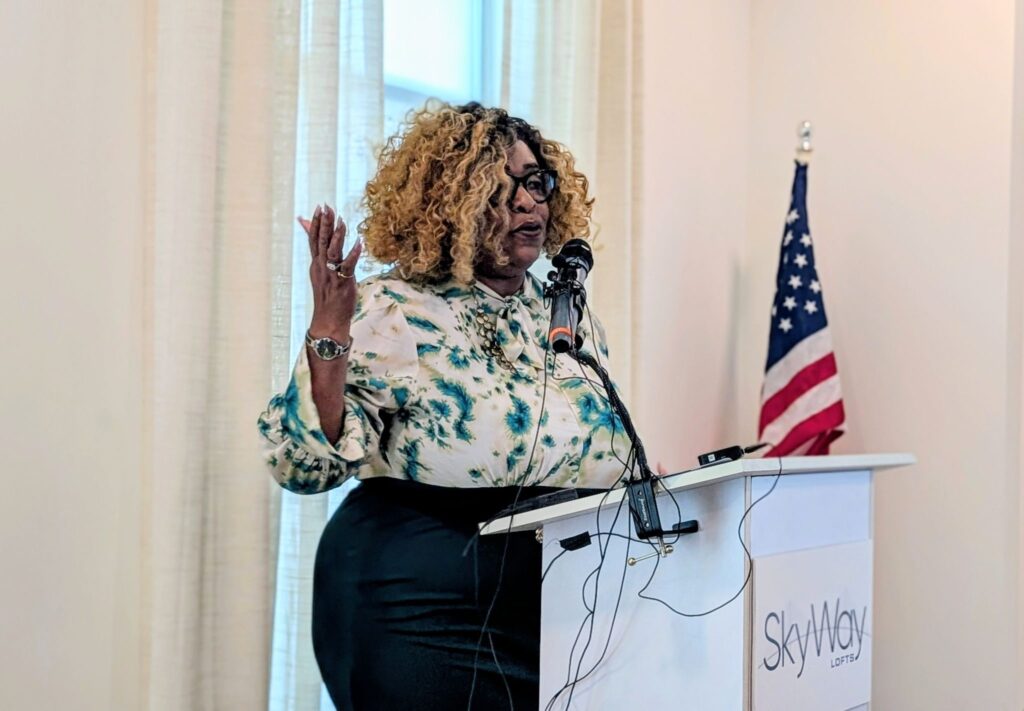
Pinellas County Commissioner Renee Flowers chairs the Human Rights Board and is a staunch supporter of the office it governs. Photo by Mark Parker.
Pinellas County is no longer considering dismantling the department responsible for protecting residents from several forms of discrimination after an independent report highlighted its value.
Commissioner Chris Scherer recommended eliminating the Office of Human Rights in August 2025, amid Florida Department of Government Efficiency (DOGE) audits and efforts to lower property taxes. The department ensures fair access to local employment, housing, government assistance, and public accommodations, works to recover wage theft, and offers anti-harassment training.
Scherer thought that state and federal agencies could fill the void left by eliminating the office and transferring employees, saving the county $1.5 million annually. He expressed a change of heart at a commission workshop on Thursday.
“They do a lot of great work,” Scherer said of the office. “And I learned that myself.”
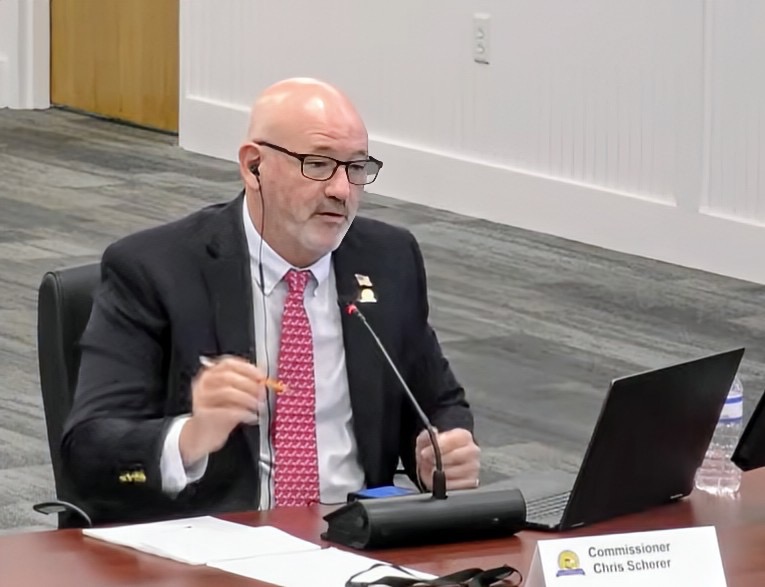
Pinellas County Commissioner Chris Schere proposed abolishing the Office of Human Rights in August 2025. Image: Screengrab.
Pinellas was required to establish its Office of Human Rights in 1977 following threats of a lawsuit by the U.S. Department of Justice over discriminatory hiring practices. A federal court order in 2014 released the county from that mandate.
In 2016, commissioners passed an ordinance that restructured the department and established a governing Human Rights Board. Commissioner Renee Flowers is the chairperson.
After Thursday’s workshop, Flowers said the partnership between the office, Pinellas County Government, 27 municipalities, and the U.S. Department of Housing and Urban Development (HUD) is a “prime example of what it means to be accessible and available to serve and improve the quality of life for residents.”
“The task is to ensure that an avenue exists for residents to seek a solution to an unimaginable concern,” Flowers told Power Broker Magazine. “I could not be more proud to serve as its chairman, and will continue to advocate for an office comprised of people who desire to see to the needs of people.”
Scherer’s formal recommendation to restructure the office received little support from his colleagues on the commission in August, despite state leadership also advocating for similar departmental cuts and property tax reductions. However, the commission agreed to further discuss the office’s future at another workshop.
“Last year, you asked us to look at the Office of Human Rights and what they did, and whether the program was needed, either in part or in whole,” County Administrator Barry Burton said Thursday. “As we began looking at this, it got really complicated really quickly, because they do a lot of things …”
For example, Burton said the office helps secure grants and works closely with the transportation department. He hired an independent firm, Local Government Solutions (LGS), to compile data and present a report.
Alan Rosen, CEO of LGS, explained that the Office of Human Rights has a decentralized governance structure. In addition to Flowers and Burton, its governing board includes the county’s clerk of the circuit court, supervisor of elections, tax collector, property appraiser, and multiple other local officials.
Flowers said several board members expressed support for the office before the workshop. She also noted that the county’s Council for Persons with Disabilities operates under the Office of Human Rights umbrella, and her appointee, St. Petersburg Councilmember Deborah Figgs-Sanders, attended the meeting in a show of solidarity.
Rosen noted that the office’s budget will decrease by $89,000 in fiscal year 2027. He said revenues, which depend on federal reimbursement timelines, are extremely volatile.
Limited recommendations included increasing cost-recovery efforts, whether through government funding or businesses found liable for wage theft. “The main point here is what happens to your customers if you decide you don’t want to do these programs,” Rosen said.
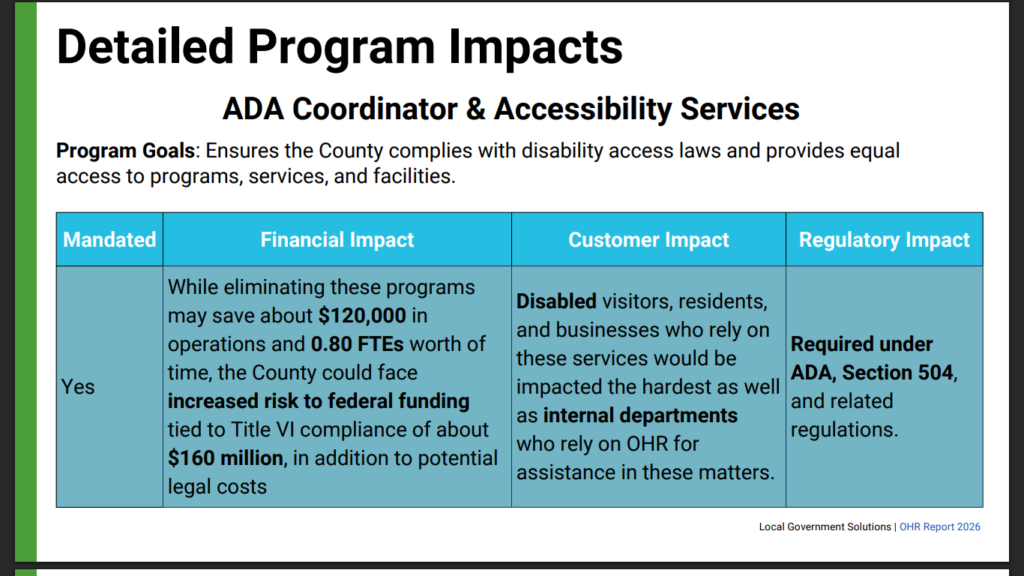
A graphic highlighting that the county could save $120,000 annually by eliminating a program that ensures compliance with disability laws, but risks losing approximately $160 million in federal funding. Image: County documents.
Some local, state, and national initiatives, including fair access to housing and employment, overlap. Rosen said the primary difference is that the county works with small organizations, unlike the federal government, to find resolutions.
In addition, the office offers a significantly faster response time. “As you know, if you’ve worked in housing or homelessness, every day counts when you’re in that situation,” Rosen said.
The state does not offer a wage theft program, and the federal government will only address businesses with over $500,000 in annual revenue. The only recourse for affected residents would then be a civil suit, and most attorneys will not take their case as the “threshold for them making any money is so low.”
“You’re balancing cost savings against access and timelines and local control of services,” he said of the office’s potential dissolution.
Flowers said that prospect was “very concerning” for the department’s staff. They “stayed on board and have continued to do their jobs with a level of excellence that goes above and beyond,” despite the resulting angst.
Commissioner Chris Latvala said he “certainly would not support getting rid of those services.” Scherer expressed the importance of periodically evaluating departments.
“When I originally looked at the department, I saw a lot of overlapping jurisdictions and expenses; I still do,” Scherer added. “But if nobody has any interest in eliminating the duplicative efforts … then that will be that.”
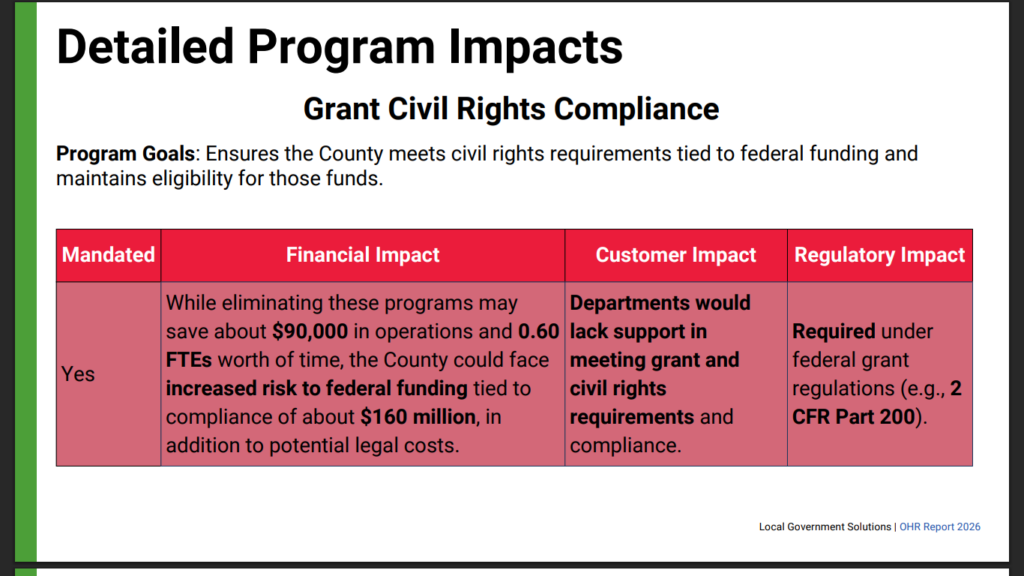
A graphic highlighting that the county could save $90,000 annually by eliminating a program that ensures compliance with civil rights requirements, but risks losing approximately $160 million in federal funding. Image: County documents.
Share Your News with Us
To share news with the Power Broker, reach out to reachout@powerbrokermagazine.com. To sign up for our twice-weekly e-newsletter, visit www.powerbrokermagazine.com; and to join our online conversation, subscribe to our YouTube channel at Power Broker Media Group – YouTube.
More Photos
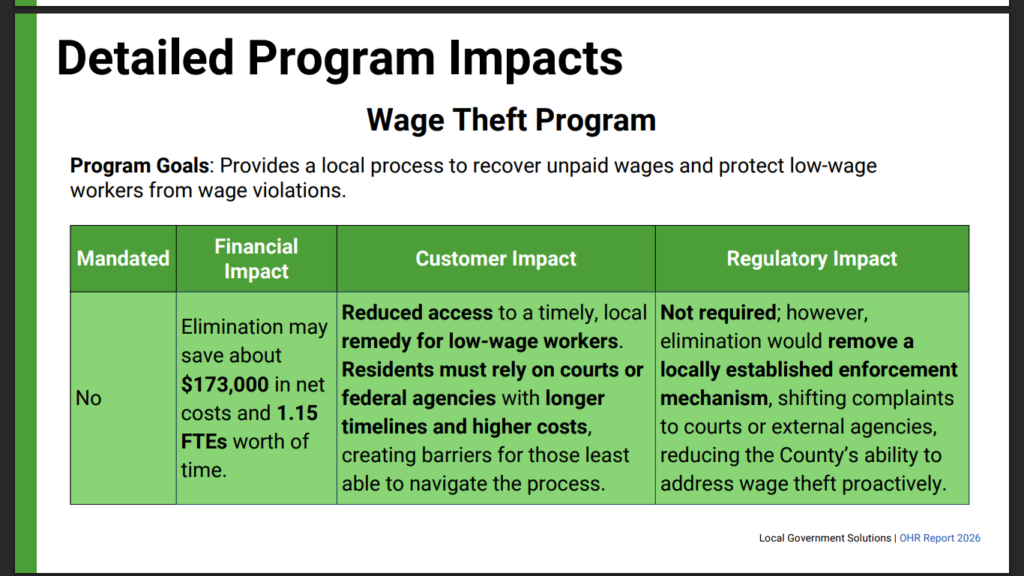
A graphic highlighting that eliminating the local wage theft program would save roughly $173,000 annually but also increase barriers for affected residents. Image: County documents.
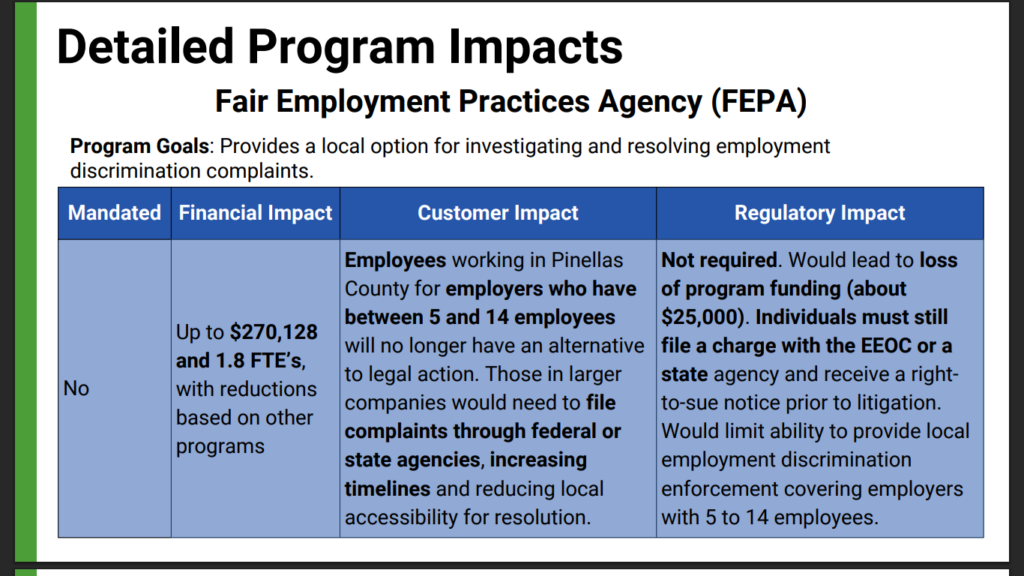
A graphic highlighting that eliminating the fair employment program would save the county up to $270,128 annually but leave affected residents employed by a small business with no recourse. Image: County documents.
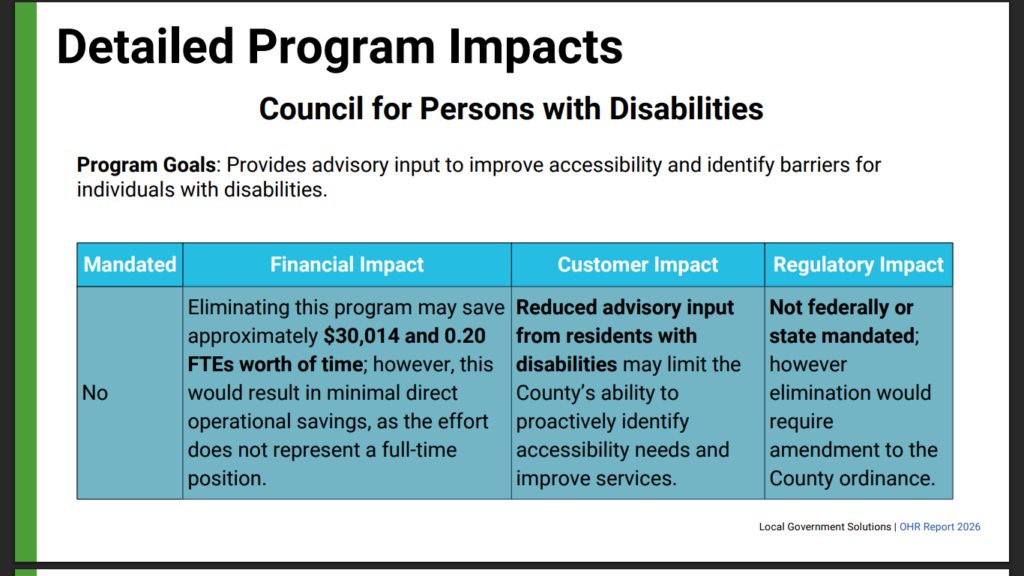
A graphic highlighting that eliminating the Council for Persons with Disabilities could save the county $30,024 annually, which does not represent a full-time position.