
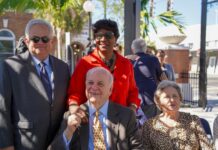





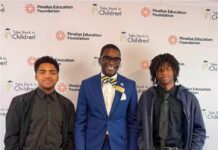





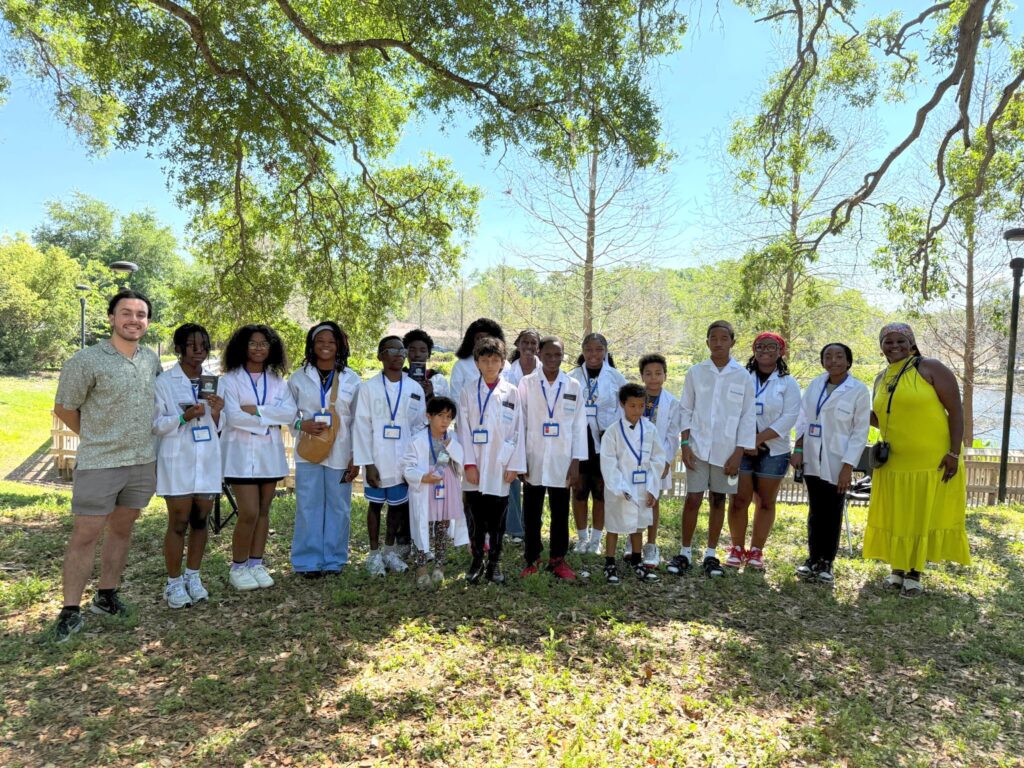
Cobb, far right, FLOWERS Youth participants, and Daniel Arango, USF Civil Engineering student, far left. Image courtesy of Dominique Cobb.
When clean water becomes harder to protect, communities cannot afford to wait until a crisis reaches their front door. Families need to know where their water comes from, how to care for it, how to test it, and how to teach the next generation to see water as a source of life, health, and responsibility.
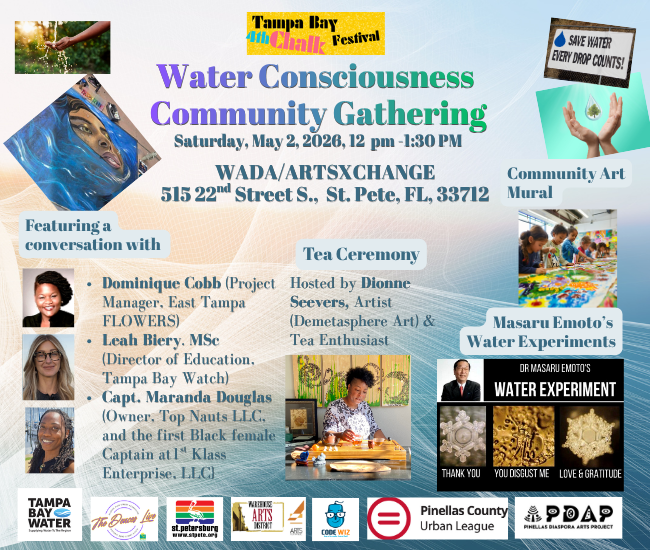
That urgency is guiding the first Water Consciousness Community Gathering, taking place Saturday, May 2, from noon to 1:30 p.m. at WADA ArtsXchange, located at 515 22nd Street S. in St. Petersburg.
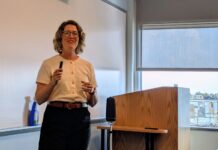
The Water Consciousness Community Gathering will feature a conversation with Dominique Cobb, project manager for FLOWERS – Future Leaders of Water, Engineering, Research, and Science – a program through the Tampa Heights Junior Civic Association (THJCA)
The gathering is part of the 4th Tampa Bay Chalk Festival, which runs from 10 a.m. to 4 p.m. on 22nd Street between 7th Avenue S. and 9th Avenue S. This year’s festival theme is “Our Watery Futures,” bringing sidewalk art, community learning, and environmental awareness into one public space.
The Water Consciousness Community Gathering will feature a conversation with Dominique Cobb, project manager for FLOWERS – Future Leaders of Water, Engineering, Research, and Science – a program through the Tampa Heights Junior Civic Association (THJCA). In East Tampa, Cobb directs the program’s youth-centered work around water, STEM, and environmental stewardship.
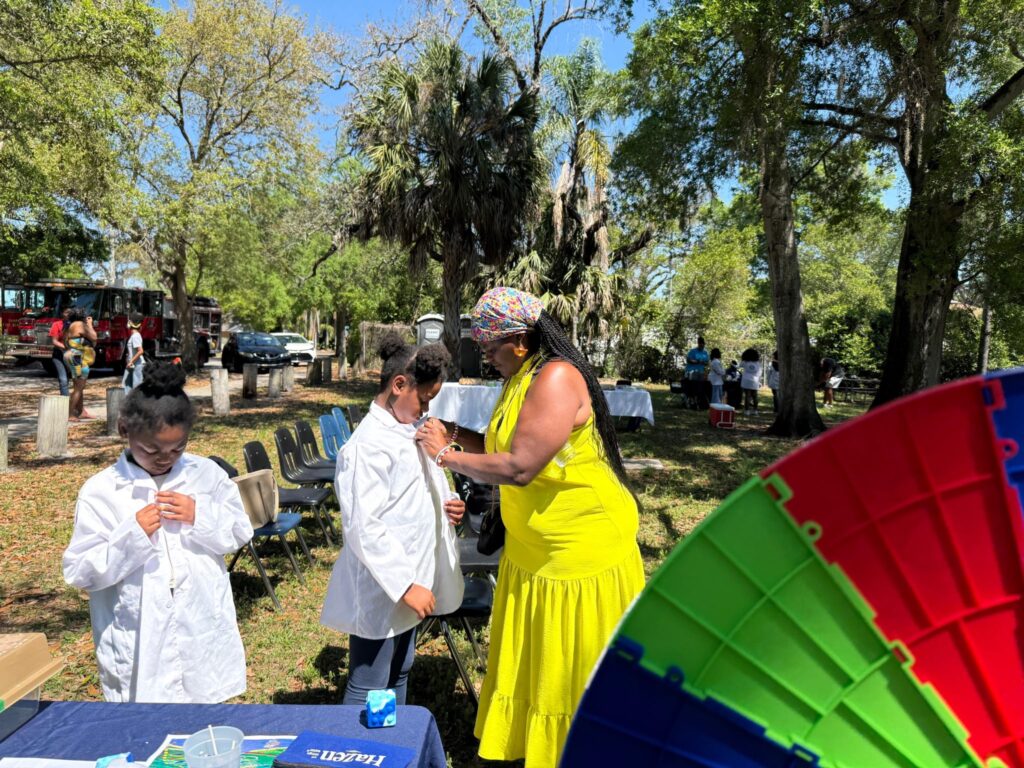
Through FLOWERS, Cobb introduces students to water science, engineering, research, public health, and environmental stewardship through hands-on learning and community partnerships. The program began with a focus on East Tampa and has already reached students from more than 17 schools across three counties. Image courtesy of Dominique Cobb.
The event will also feature Leah Biery, director of education for Tampa Bay Watch, and Captain Miranda Douglas. Community members can expect a tea ceremony hosted by Dionne Seevers, a community art mural, and images from Dr. Masaru Emoto’s water experiments.
For Cobb, the conversation is directly tied to the work she has been building with youth and families in East Tampa.
FLOWERS introduces students to water science, engineering, research, public health, and environmental stewardship through hands-on learning and community partnerships. The program began with a focus on East Tampa and has already reached students from more than 17 schools across three counties.
In her role, Cobb develops programming that helps students understand water, the environment, and the power they have to advocate for their communities.
“What I do in that role is create different programs where we are focused on water, environment, and being environmental stewards,” Cobb said. “I connect with not only the community, but I look at the temperature of what’s going on politically and make sure our children are involved.”
Cobb’s work with FLOWERS grew out of what she learned in the 2025 Pinellas County Water Steward Program, which helped her better understand fresh water sources, water systems, conservation, and the organizations connected to water access.
“The things that I learned there, I’m like, how could I take this to not only my community, but be that liaison with my community and implement some of that knowledge and some of those resources,” Cobb said.
That idea helped shape FLOWERS; Cobb wanted to take water education that often lives in formal programs, government meetings, or professional circles and place it directly in the hands of students and families.
The program uses hands-on lessons to help young people understand the role water plays in daily life and future careers. Students learn through water testing, environmental activities, field experiences, and real-world problem solving. Cobb said the goal is to make science feel close, practical, and possible.
The work is already growing. Cobb said FLOWERS recently completed its first cohort after sessions that moved from a public library to a middle school, a community pond, and the Hillsborough County Water Treatment Center. Students continued showing up, and families have asked when the next session will begin.
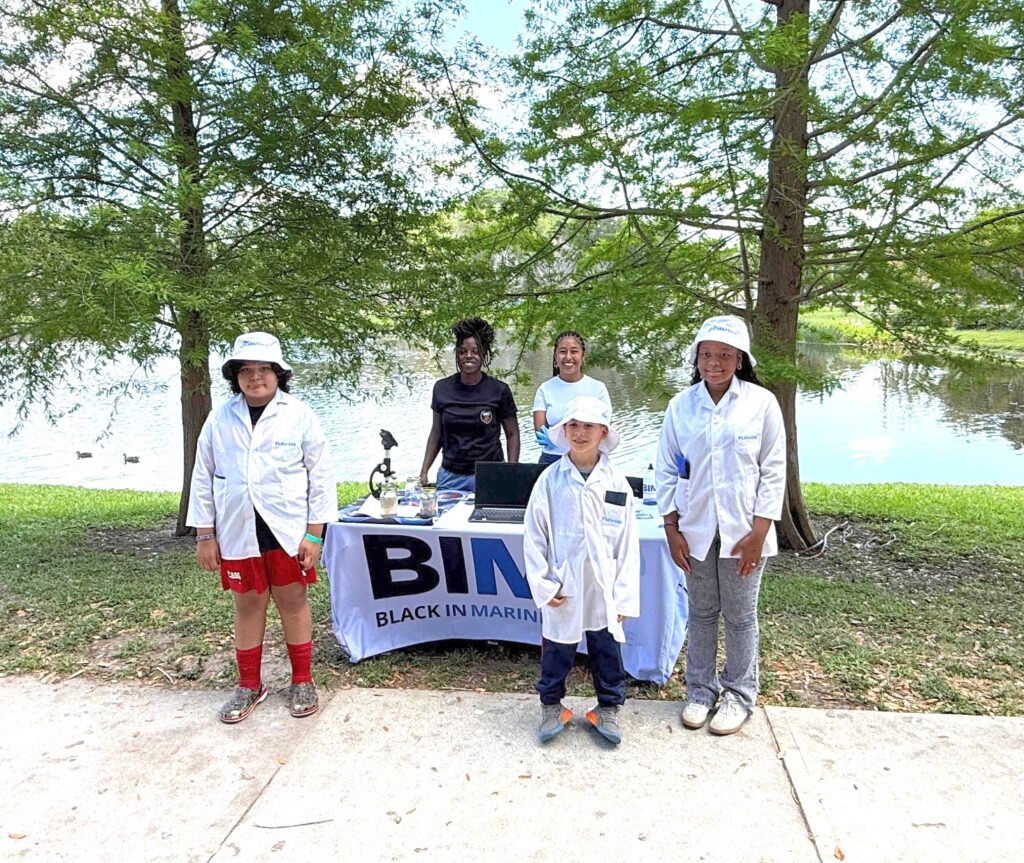
Cobb wanted to take water education that often lives in formal programs, government meetings, or professional circles and place it directly in the hands of students and families. Image courtesy of Dominique Cobb.
That response speaks to a larger need.
“Water is life. Water is essential,” Cobb said. “And if we don’t know how essential water is, we could lose it.”
At Saturday’s gathering, Cobb plans to speak about the importance of water in everyday life, including drinking, cooking, cleaning, and caring for the body. She also wants people to understand water scarcity, conservation, and how families can identify clean water sources during emergencies.
“I wanted to bring community and culture together and talk to the community about how important water is,” Cobb said. “Water is necessary in everything, whether we drink, cook, or use it to cleanse our body.”
Cobb said many students and parents she has worked with did not know how limited clean drinking water can be or what steps they could take if they needed to find or test safe water. That is why she believes education has to reach people in familiar places and at times when families can actually attend.
Water education is also becoming a pathway into future careers. Through FLOWERS, students are being introduced to science, marine work, environmental research, public health, and infrastructure in ways that connect directly to their own neighborhoods.
“I want our community to be able to be in nature and know that they belong there, especially our children,” Cobb said. “If I have the knowledge and the access, I’m going to make sure we are in the space and in the place, and we’re going to learn, and we’re going to take it back, because this is our birthright.”
At the Water Consciousness Community Gathering, residents, families, and youth will have a chance to connect those lessons to the future of Tampa Bay’s waterways and the communities that depend on them.
“I hope that through my work in the community, or what we will be doing this weekend as well, we can put the emphasis on how important water is at the level of conserving and also researching it,” Cobb said.
For those who want to support this work beyond Saturday, FLOWERS is continuing to build summer programming and partnerships for students. Community members, organizations, and supporters interested in helping expand access to water education, youth learning, and environmental stewardship can connect with East Tampa FLOWERS through the Tampa Heights Junior Civic Association, https://www.thjca.org/contact; by phone at 813-468-3608, or email admin@thjca.org.
Share Your News with Us
To share news with the Power Broker, connect with reachout@powerbrokermagazine.com. To sign up for our twice-weekly e-newsletter, visit www.powerbrokermagazine.com; and to join our online conversation, subscribe to our YouTube channel at Power Broker Media Group – YouTube.