














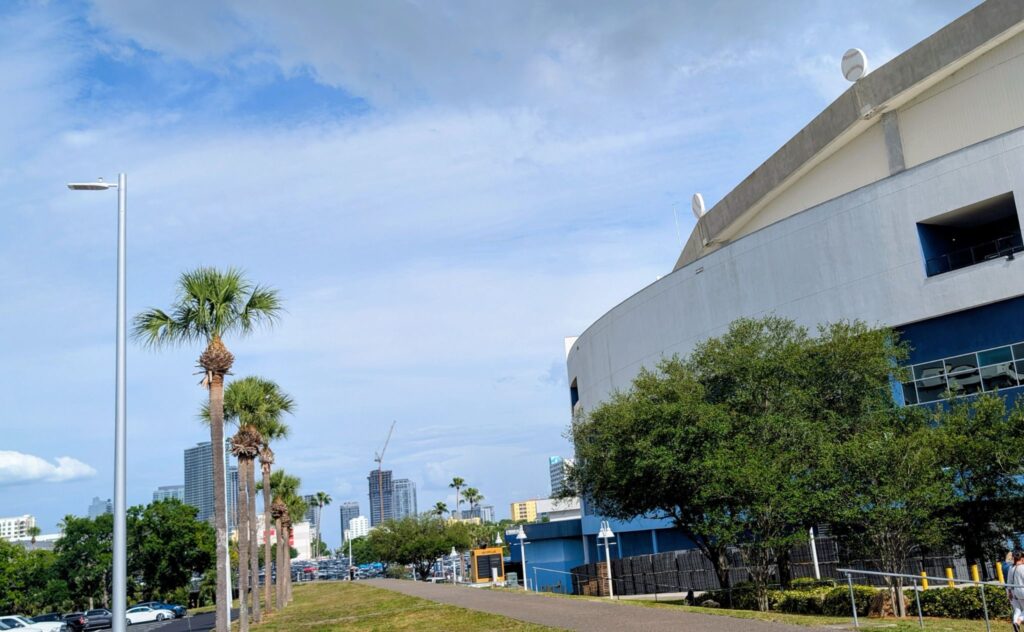
Multiple city council members want St. Petersburg Mayor Ken Welch to wait for the results of an Urban Land Institute study before selecting a developer to reimagine the Historic Gas Plant District. His administration prefers to complete the work simultaneously. Photo by Mark Parker.
St. Petersburg Mayor Ken Welch plans to select a proposal to redevelop the Historic Gas Plant District, currently home to Tropicana Field, in June. Negotiating a term sheet will take another year.
A city council committee and administrators discussed what some believe is a rushed timeline and the role of the Urban Land Institute (ULI) in the process on Thursday. Welch recently announced a “slight adjustment” to incorporate feedback from ULI, the world’s largest network of land use experts.
Lee Lowry, executive director of ULI Tampa Bay, said the nonprofit will “fast-track” the study while city officials conduct community engagement and analyze shortlisted proposals. Councilmember Gina Driscoll asked if the administration would select a developer and negotiate terms before receiving a final report.
While a selected developer would work with the ULI as it completes the study’s second phase, City Administrator James Corbett does not expect a project term sheet until the end of the year or early 2027 – several months after municipal elections in November. He believes the summer of 2027 is a “realistic” target date for the council to approve formal agreements.
“There are some who say that this is moving very fast, and so that really helps put things in perspective,” said Driscoll.
While she felt “a little bit better” about the timeline, Councilmember Corey Givens Jr. expressed ongoing concerns regarding a potentially rushed ULI study. He wants to ensure the organization has adequate time to “provide a fleshed-out recommendation for what should be done at this site.”
“I want to know what the benefits are citywide when we redevelop this site,” Givens added. “How does it help the entire City of St. Pete, not just those 86 acres?”
The study
Councilmember Brandi Gabbard requested Thursday’s discussion in October 2025, two weeks after the city received an unsolicited redevelopment proposal from Ark Ellison Horus. Four days later, Welch announced that he would launch the land disposition process and accept additional bids.
In early February, the council, in a 6-2 vote, approved a nonbinding resolution urging Welch to “pause any action” related to the proposal process and conduct additional planning. He disagreed with “that need.”
“We’ve been planning for more than a decade,” Welch told Power Broker Magazine in late March. “We’ve done a lot of planning since then.”
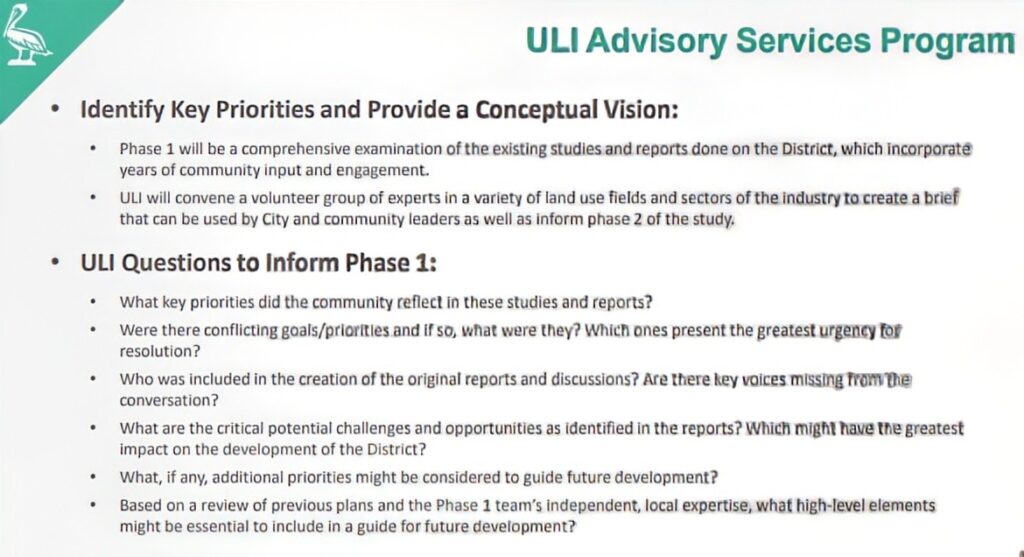
A graphic outlining the study’s first phase. Image: City documents.
Councilmember Mike Harting questioned the administration’s current support for the ULI study on Thursday. He asked if city officials are “really going to make this part of the process,” or if they were “just talking about it on the surface to try and find a way for us to get along.”
City Administrator Rob Gerdes said Welch’s team, through productive conversations with ULI representatives, realized the study could be “very beneficial to developing the term sheet and the overall development.”
“So, based on those discussions, there appeared to be a path forward where we could cooperate with the resolution and the city council’s request, continue on a reasonable timeline, and make it a positive for the process that we’re doing,” Gerdes concluded.
The St. Petersburg Downtown Partnership is raising funding for the study’s estimated $135,000 first phase. CEO Jason Mathis said multiple other stakeholders have expressed interest in contributing.
A volunteer group of ULI experts will analyze and aggregate previous redevelopment studies and years of community feedback. The overarching goal is to identify key priorities and provide a conceptual vision, Lowry said.
The ULI will “bring it all together in a concise report” and ensure there are no “voices missing,” Lowry added. She also emphasized the organization’s focus on transparency and eliminating biases.
“I’m grateful to see how phase one is laid out,” said Councilmember Richie Floyd. “There’s a lot of questions to be answered around what goes on beyond that, but I think this is a good start.”
Lowry said the ULI could complete the first phase by the end of May. The second will take three to four months “from the time we sign the contract.”
City officials have yet to establish a scope for the second phase, and multiple council members expressed concern over the administration selecting a developer before receiving the study’s final recommendations. “I believe we can do both together,” Corbett said.
“The reason that ULI brings value is because they are an independent third party,” Gabbard said. “They do not have any financial gain in what eventually happens at the site. And I think that is critical, because once we start engaging developers … the scope changes, and the output will change.”
The city will host a public meeting with shortlisted developers at The Coliseum on April 30, and Gabbard noted that “time is certainly of the essence.” Committee members approved her motion for the administration to provide a draft scope of work for the study’s second phase within two weeks.
Share Your News With Us
To share news with the Power Broker, email us at reachout@powerbrokermagazine.com. To sign up for our twice-weekly e-newsletter, visit www.powerbrokermagazine.com; and to join our online conversation, subscribe to our YouTube channel at Power Broker Media Group – YouTube.