















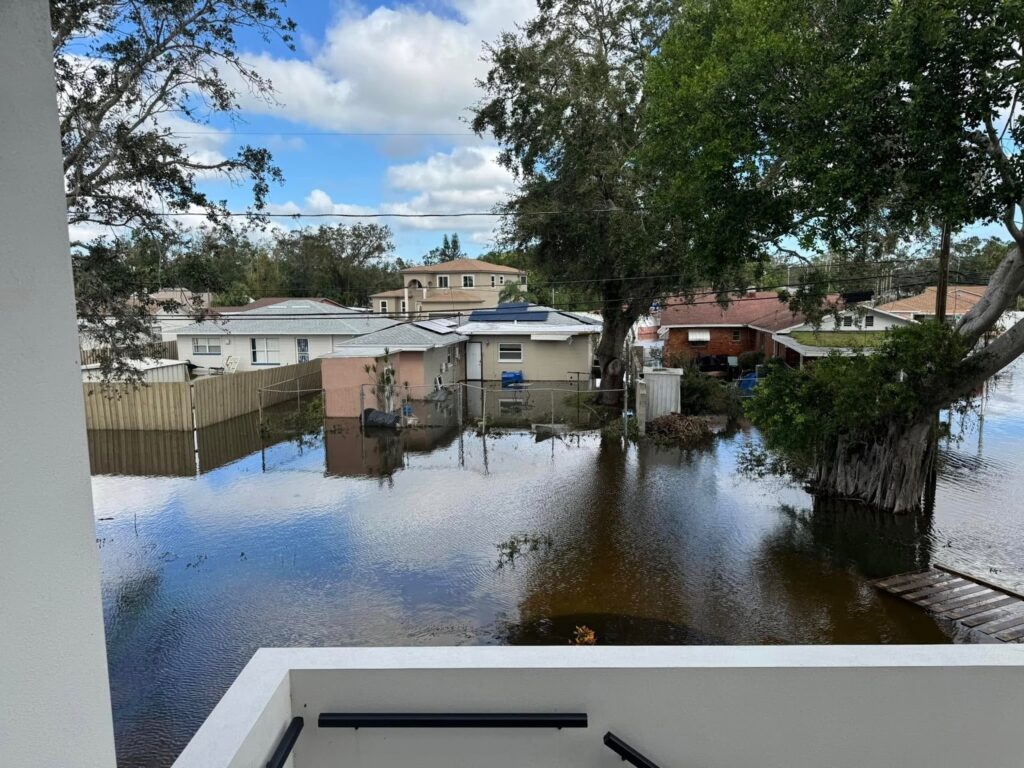
Flooding around Lake Maggiore after Hurricane Milton. Photo: Heather Davidson, Facebook.
St. Petersburg is finalizing plans for a Voluntary Buyout Program that will offer homeowners in strategic areas up to $400,000 for storm-damaged properties and relocation incentives.
Residents in high-risk areas, including parts of South St. Petersburg, can receive up to $50,000 to purchase or rent a new home, $10,000 to move to higher ground, and $5,000 to remain in the city rather than relocate. The $5 million initiative is part of the $160 million Sunrise St. Pete disaster recovery plan.
A city council committee heard a program update on March 12. Mayor Ken Welch’s administration plans to purchase 14 strategically located properties when the initiative launches in the spring or summer.
“I want to make sure that those who need the help the most – get the help,” said Councilmember Corey Givens Jr. “And if we can keep residents here in St. Pete, I want to focus on that.”
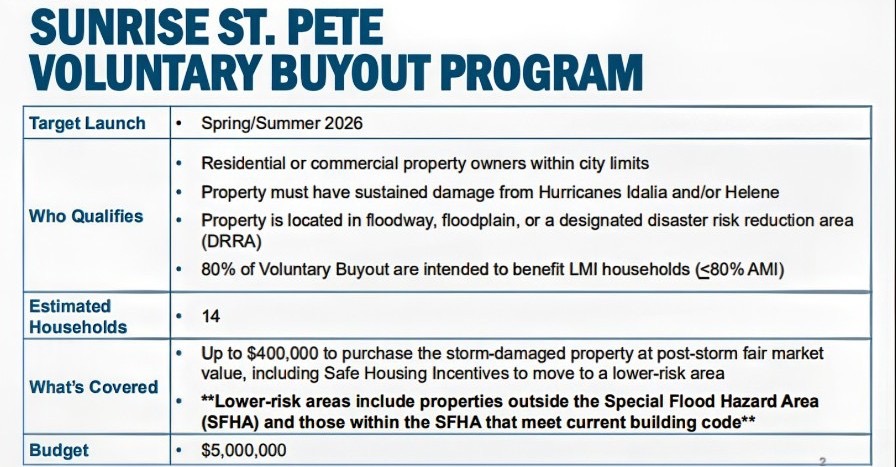
The city plans to purchase 14 eligible homes at fair market value, up to $400,000. Image: City documents.
Properties within a floodplain or designated risk reduction area that sustained damage during Hurricanes Idalia or Helene could qualify. At least 80% of the voluntary buyouts will benefit households earning up to 80% of the area median income (AMI).
The city will convert purchased parcels into open space or dedicate the land to stormwater management and flood mitigation uses. Officials will prioritize contiguous, repetitive loss homes – particularly those adjacent to parks or city-owned properties.
Staff will notify eligible property owners about the program before conducting assessments and prioritizing parcels via a ranking system. Residents earning up to 120% of the AMI can receive $50,000 in down payment assistance to purchase a home in Florida with a reduced risk of flooding.
Residents earning up to 80% of the AMI can receive up to $50,000 to move into an affordable rental unit in Florida for a year. There are no income requirements for a $10,000 incentive to relocate to an area with a reduced flooding risk, and the city will offer those participants $5,000 to remain in St. Petersburg.
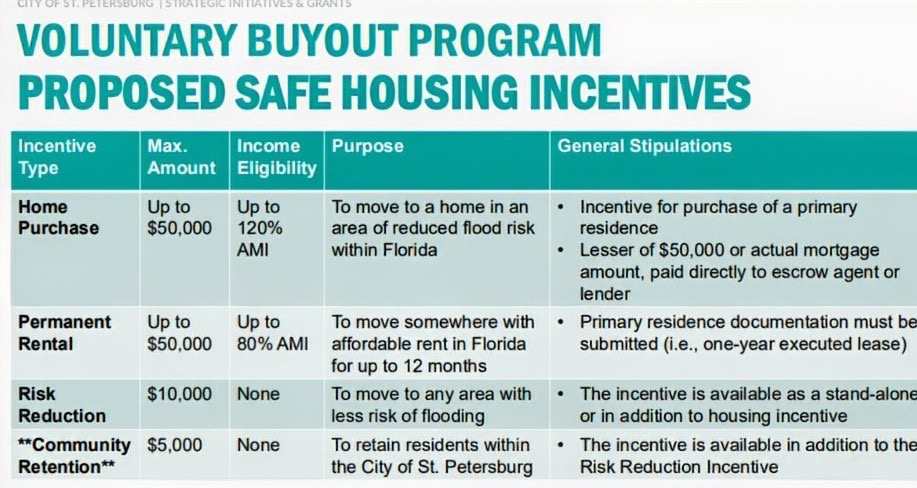
A graphic highlighting relocation incentives. Image: City documents.
Councilmember Brandi Gabbard believes the city should target single-family homes that could increase natural shorelines rather than multifamily properties. “We’re not going to be able to do a large amount of these, and I really think we’re going to have to have a laser focus on this program,” she said.
“I do not want us to use these funds for people to move outside of the City of St. Petersburg, at all,” Gabbard added. “I want this to be an initiative that helps people stay in the city.”
The committee agreed with that sentiment. City Development Administrator James Corbett said certain restrictions, including only targeting homesteaded properties, “make sense.”
However, he also explained the importance of not eliminating potential program participants. The overarching goal is to acquire contiguous lots that will increase environmental resiliency, and Corbett said that would “be difficult when you have people coming in and out of the mix based on their own personal circumstances.”
Aubrey Phillips, director of strategic initiatives and grants, said the city broadly defined disaster risk reduction areas for the same reason. Administrators will provide more precise location data before seeking the city council’s approval and throughout the iterative process.
Councilmember Richie Floyd said an in-development interactive map helped him visualize the city’s intent. “If we were to have a good number of homes turn into mitigation properties, especially around a creek – you can see how stormwater drainage areas would be really beneficial here.”
“Whatever detail you can provide like this in the future just makes my life easier, and I assume that a lot of my colleagues would agree,” Floyd added.
Phillips said the “excellent amount of feedback” will help the administration refine program parameters. The city’s deadline for publishing general guidelines, which officials can “always go back and revisit,” was Saturday.
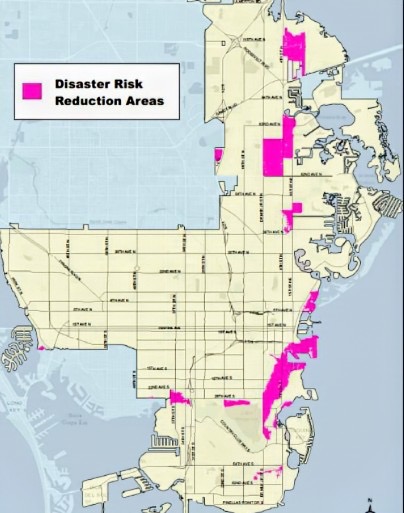
A map highlighting eligible disaster risk reduction areas (pink). Image: City documents.
Share Your News with Us
To share news with the Power Broker, connect with reachout@powerbrokermagazine.com. To sign up for our twice-weekly e-newsletter, visit www.powerbrokermagazine.com; and to join our online conversation, subscribe to our YouTube channel at Power Broker Media Group – YouTube.