
















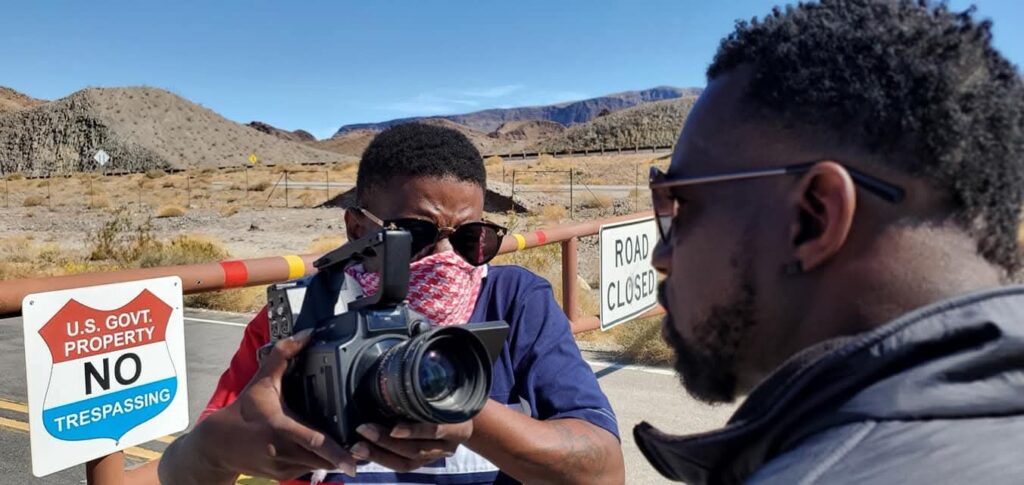
Cranstan Cumberbatch (pictured right) is co-founder of DreamMakerz Productions, and a Tampa Bay independent filmmaker, actor, and director of the Sunshine City Film Festival, the Black Art & Film Festival, the Juneteenth Film Festival, and the MLK Day Celebration Film Festival. Image courtesy of DreamMakerz Productions.
The debate about whether independent filmmakers should or should not use AI is coming from the wrong direction. The real conversation should start somewhere else: how do independent artists maximize the resources available to them so they can actually finish the work, present it at a strong level, and attract the financial backing needed to take their projects and future ideas to the next level?
For independent filmmakers, the biggest challenges have never been creativity. They are resources, time, and energy. Hollywood productions have the advantage of entire departments dedicated to bringing a vision to life. Independent filmmakers rarely have that luxury. Many of us wear five to ten hats just to complete a single project.
I know this firsthand because I am that guy. I have written scripts, directed projects, acted in films, helped with casting, assisted with lighting setups, spent countless hours editing, worked on marketing materials, and then turned around and promoted the project myself just to get people in seats.
That is not unusual in the indie world. That is normal. Independent filmmakers often become producers, editors, marketers, location scouts, and sometimes even craft services just to keep a project moving forward.
Money is only part of that equation. Most independent filmmakers cannot afford to quit their day jobs. In many cases, that job is the very thing helping keep the dream alive. But balancing a full-time job while pursuing filmmaking introduces another challenge.
Time becomes limited. Energy becomes limited. After working all day, filmmakers still have to write, shoot, edit, promote their projects, submit to festivals, and build relationships with collaborators.
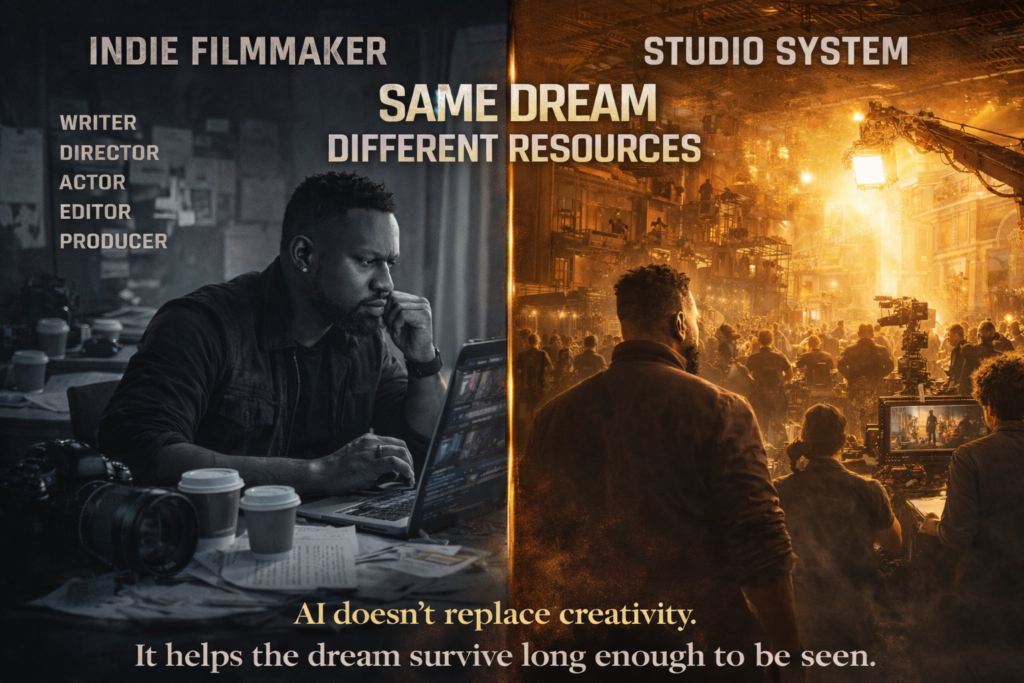
According to Cumberbatch, “AI does not replace creativity. It helps close the gap between vision and execution for independent filmmakers.” Image courtesy of Cranstan Cumberbatch.
When people talk about the purity of filmmaking without tools like AI, they often overlook something important. Filmmaking has always been a resource-driven art form. The ability to hire skilled professionals has always been tied directly to budget.
At the ultra-low budget level, projects often fall between zero and ten thousand dollars. At that stage, the filmmaker is usually the writer, director, editor, producer, and marketer all in one. Crew members are often volunteers, equipment is borrowed, and locations come through favors.
At the next level, budgets might reach ten thousand to two hundred fifty thousand dollars. This allows filmmakers to hire a few professionals, but still requires them to wear several hats. A professional editor alone may cost between three and fifteen thousand dollars. Sound design, color grading, and marketing can add thousands more.
Higher-budget independent films may range from two hundred fifty thousand to two million dollars. Even then, visual effects shots can cost hundreds of dollars each, composers can command tens of thousands of dollars, and marketing campaigns can reach fifty thousand dollars or more.
This is where tools like AI begin to change the equation. AI does not replace creativity. It helps close the gap between vision and execution for independent filmmakers.
It can assist with storyboards, concept art, pitch visuals, rough previsualization, audio cleanup, editing support, and marketing materials. These tools allow filmmakers to present their ideas more clearly and professionally than their current budgets might otherwise allow.
Another way to look at AI is this: For independent filmmakers, it should not be viewed as the full job – it is a gap filler. It is another tool that helps bridge the space between imagination and execution.
For filmmakers balancing jobs, limited budgets, and long nights of creative work, that can make the difference between a project being completed or abandoned. For the cost of a streaming subscription or a few trips to the movies each month, filmmakers can visualize scenes, create pitch materials, experiment with concepts, and refine their stories.
That is a far better position to be in than waiting indefinitely for someone to invest in a project based purely on risk. Because when a filmmaker can present a realized concept instead of just an idea, the conversation changes: Investors are no longer being asked to believe in a possibility – they are being shown something tangible. And that shift alone can dramatically increase the chances of a project moving forward.
For many independent artists, AI is not replacing the dream.
It is helping keep the dream alive long enough to be seen.
Cranstan Cumberbatch, co-founder of DreamMakerz Productions, is a Tampa Bay independent filmmaker, actor, and director of the Sunshine City Film Festival, the Black Art & Film Festival, the Juneteenth Film Festival, and the MLK Day Celebration Film Festival. For more information, visit Dreammakerzproductions.org.
Share Your News with Us
To share news with the Power Broker, connect with reachout@powerbrokermagazine.com. To sign up for our twice-weekly e-newsletter, visit www.powerbrokermagazine.com; and to join our online conversation, subscribe to our YouTube channel at Power Broker Media Group – YouTube.