














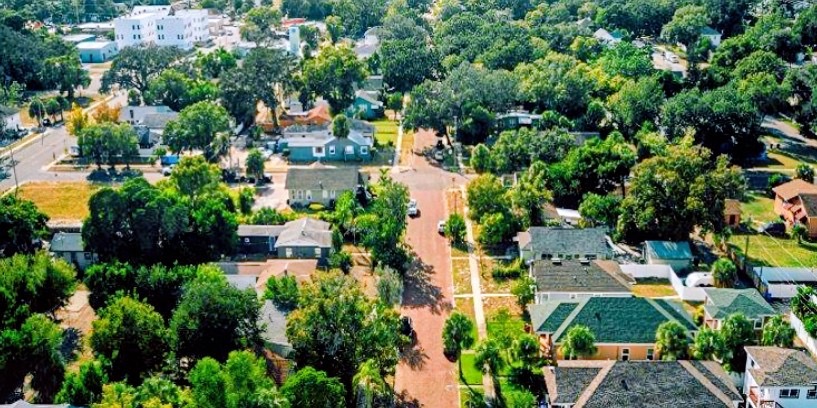
An aerial view of Palmetto Park, which, according to a new neighborhood plan, is “experiencing gentrification.” All images: City of St. Petersburg.
An evolving South St. Petersburg neighborhood along the 22nd Street South (Deuces) corridor, near the Historic Gas Plant District, has a new guiding vision for the first time since 1992.
City council members unanimously approved the updated Palmetto Park Neighborhood Plan at their March 5 meeting. The 69-page document begins by noting that the area has “attracted renewed interest from investors” and is “experiencing gentrification.”
Palmetto Park encompasses 407 acres, is home to 1,492 residents, and sits within the South St. Petersburg Community Redevelopment Area (CRA). The area “stands on the brink of a transformative era,” states the plan, a strategic framework for growth.
“The current Palmetto Park Neighborhood Plan is older than I am,” Councilmember Corey Givens Jr. told Power Broker Magazine. “It is outdated and does not reflect the true character or needs of today’s Palmetto Park.
“This new community-driven plan – crafted by residents and stakeholders over a series of workshops, conversations, and surveys – will help guide future development in Palmetto Park, and also at the neighboring Gas Plant.”

A graphic highlighting Palmetto Park (black outline), the South St. Petersburg Community Redevelopment Area (green outline), the Historic Gas Plant District (blue stripes), and the 22nd Street South Business District (purple stripes).
The area now known as Palmetto Park was once subjected to redlining, which prevented prospective homebuyers from obtaining mortgages in predominantly Black neighborhoods during segregation. However, 22nd Street South was a thriving commercial corridor during the city’s Jim Crow era.
Post-segregation urban renewal efforts, combined with the construction of I-275, “greatly impacted” neighborhood culture and resources, notes the plan. Mayor Ken Welch’s administration launched the Neighborhood Planning Program in 2022 to help CRA communities reduce blight, improve infrastructure, preserve heritage, and balance growth with long-term stability.
Neighborhood relations manager Kayleigh Sagonowsky said the program includes three pots of much-needed funding. The city hired Orlando-based Inspire Placemaking Collective, Inc. to facilitate neighborhood engagement, which began in December 2023, and to write the plan.
Palmetto Park, bordered by 34th Street to the west and 22nd Street to the east, sits between the Grand Central and Warehouse Arts Districts. “So, this site is really primed for opportunity,” Sagonowsky said.
Inspire Placemaking collaborated with community members and city staff to evaluate Palmetto Park’s streets, homes, and destinations across five key attributes: Connectivity, inclusivity, well-being, resiliency, and empowerment.
Approximately 88% of neighborhood residents rely on private vehicles, with just 6% utilizing public transportation or bicycles. Sagonowsky said one of the plan’s “biggest takeaways” was that the community wants “more complete streets improvements” to help increase the number of pedestrians and bicyclists.
Potential projects include repairing or installing sidewalks and bike lanes, adding signalized crosswalks, and intersection improvements, which could include new signage, lighting, and shade trees. Residents would like to see additional benches, pavilions, outdoor fitness stations, picnic areas, dog amenities, and increased connectivity along the Pinellas Trail.

The plan highlights “large homes built to maximize use of the lot (left) that are not consistent in scale to adjacent homes.”
The plan’s implementation ideas also include wayfinding signage, enhanced recreational amenities, and new mixed-use developments to infill vacant or underutilized lots. Sagonowsky said increasing food access “could be through something smaller, like identifying a site for a pop-up farmer’s market on the weekend, or something larger, like increasing grocery options throughout the neighborhood.”
Stakeholders want the city to address illegal dumping and believe that additional pedestrian lighting and properly maintained landscaping will increase safety. “When people know that a neighborhood is well taken care of, they’re less likely to commit crimes in the area,” Sagonowsky said.
Projects within the approved plan are now eligible for city and CRA funding. Councilmember Gina Driscoll called Palmetto Park an “active neighborhood that really knows how to use their voice to get things done.”
Sagonowsky said residents have already provided a list of implementation priorities, and city officials are now ensuring that “all those things are feasible.”
Driscoll noted that the CRA is “huge,” and people often fail to see progress due to “spread out” projects. “If we can concentrate the funding on some of these items, I think that we could really show the strength of the South St. Pete CRA, and what it does for its residents,” she said.

A community garden in Palmetto Park.
Share Your News with Us
To share news with the Power Broker, connect with reachout@powerbrokermagazine.com. To sign up for our twice-weekly e-newsletter, visit www.powerbrokermagazine.com; and to join our online conversation, subscribe to our YouTube channel at Power Broker Media Group – YouTube.