












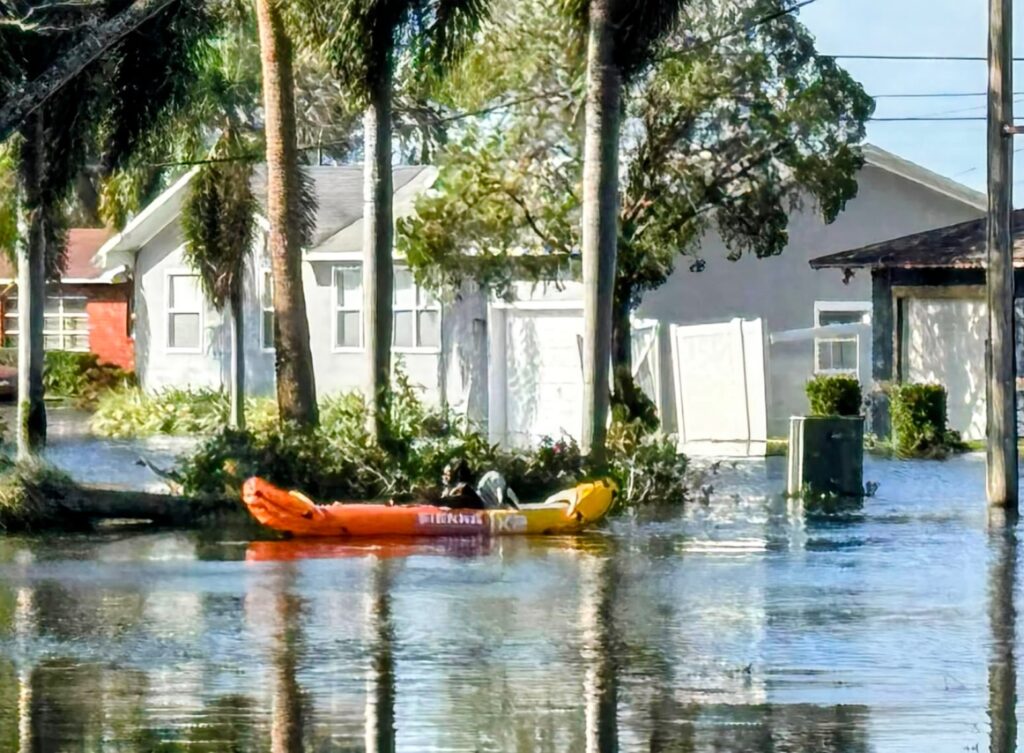
Flooding around Lake Maggiore following Hurricane Milton. Representatives from several South St. Petersburg neighborhoods are helping refine new technology that mitigates increasing environmental risks. Photo: Heather Davidson, Facebook.
Researchers at the University of South Florida St. Petersburg and a group of neighborhood leaders, known as the Storm Squad, are utilizing new technology to help vulnerable communities mitigate the impacts of flooding.
The CRIS-HAZARD app utilizes crowdsourced data, cameras with computer vision, and artificial intelligence (AI) to measure flood depths, create 3D inundation maps that predict building damage, and improve storm models. Residents can view and upload a wealth of critical information, including photos, in real-time.
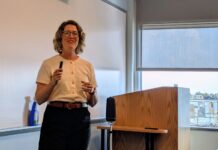
Dr. Barnali Dixon, executive director of USF’s Initiative on Coastal Adaptation and Resilience (iCAR), provided city council members with an update on the evolving platform’s capabilities at a committee meeting on Thursday. Storm Squad executive board member Erica Hall highlighted how primarily South St. Petersburg neighborhoods are helping develop and test the app while supporting their community in the process.
“CRIS is not just an app – it is a data-driven backbone,” Hall said. “It includes camera installations across neighborhoods, AI-supported flood-depth monitoring, integration of social vulnerability data, and actionable dashboards for you all, decision makers.
“Dr. Dixon has positioned St. Petersburg as a living laboratory for coastal adaptation, where research, community engagement, and policy intersect. And Storm Squad stands on that foundation.”
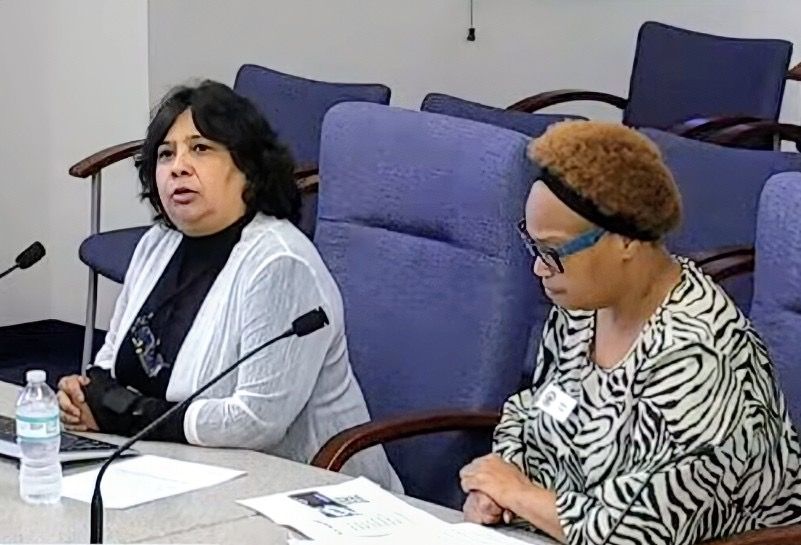
Dr. Barnali Dixon (left), executive director of USF’s Initiative on Coastal Adaptation and Resilience (iCAR), and Storm Squad executive board member Erica Hall. Photo: Screengrab.
Dixon, armed with a $1.5 million National Science Foundation (NSF) grant, piloted the platform in 2023. The app launched publicly in September 2024, just days before Hurricane Helene’s storm surge inundated the area.
While the platform encompasses Pinellas County, Dixon said there is a “special emphasis” on St. Petersburg neighborhoods. Representatives from Bartlett Park, Harbordale, Childs Park, Jordan Park, Campbell Park, Palmetto Park, and Lake Maggiore Shores have joined the Storm Squad.
Dixon noted that increasing environmental threats uniquely affect communities, which creates the need for customized, data-driven solutions. For example, flooding in an area with industrial facilities or a dog park will have “different health implications.”
The county and city are the only areas nationwide with “such a system,” Dixon said. CRIS-HAZARD’s cameras withstood Helene and Milton, which “speaks for the robustness of the methods we developed.”
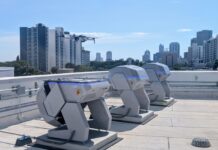
St. Petersburg is home to 17 of 32 solar-powered flood monitoring cameras, developed at USFSP. Dixon said her team is installing four additional devices, all with backup power sources and night vision, throughout the city.
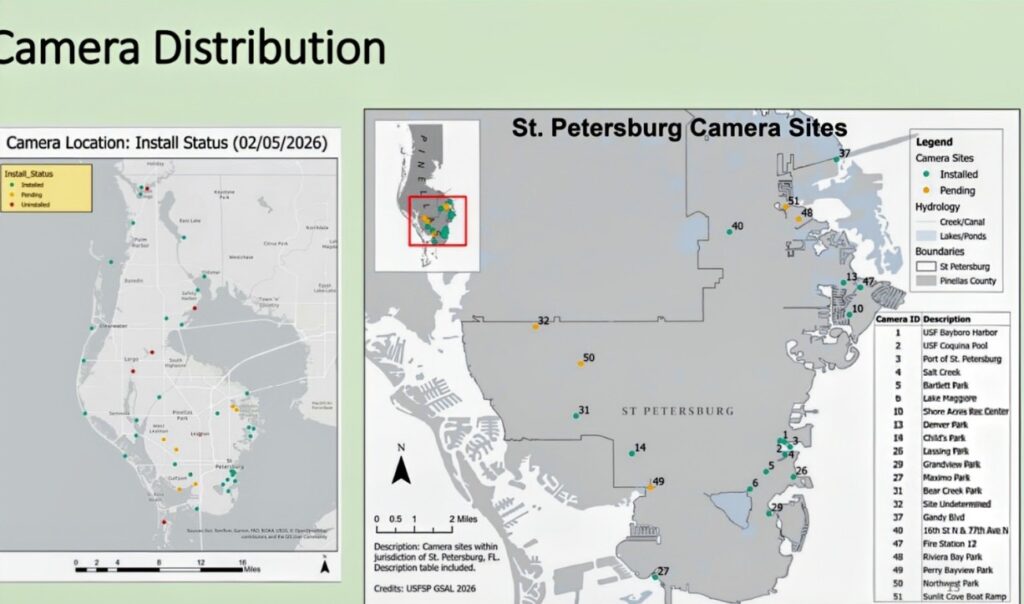
A graphic highlighting camera locations. Image: City documents.
The free, operating system-agnostic app helps users prepare for storms, avoid flooded roads, and complete damage assessments. Dixon said it could also assist first responders.
“I can build a sophisticated flood app, but if nobody is using it, it has no use,” she added. “So, we walked with the community, and that’s when the Storm Squad came in.”
Hall said the Storm Squad provides real-time flood reporting, community data collection, disaster preparedness education, and a direct connection to relief resources. “This is not a theoretical climate conversation – this is neighborhood-level resilience.”
Community members interpret the initiative’s survey data and identify local priorities. Hall credited Angel Torres, president of the Harbordale Neighborhood Association, and Bartlett Park representatives for securing hurricane relief supplies from the county’s Office of Emergency Management.
Some neighborhoods excelled in reporting, and Hall applauded others for community outreach. She also explained how their combined efforts can mitigate economic, health, and social impacts.
“Residents are not subjects of the research,” Hall continued. “They are co-creators.”
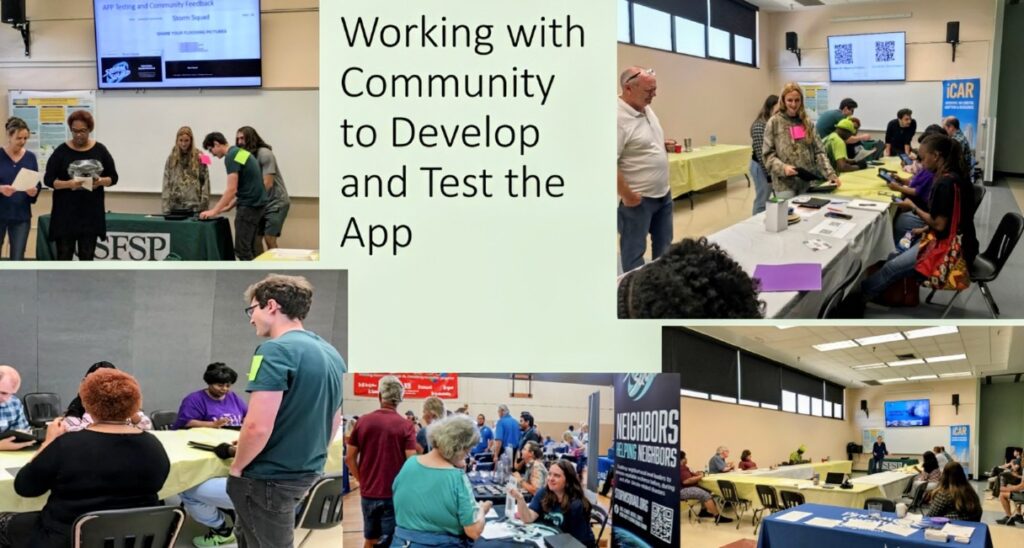
The platform paid immediate dividends in the aftermath of Hurricanes Helene and Milton. Image: City documents.
The Health, Energy, Resilience, and Sustainability Committee unanimously praised iCAR and the Storm Squad’s work. Councilmember Mike Harting called it “revolutionary.”
Councilmember Gina Driscoll wants administrators to help scale the program. Dixon said a small amount of grant funding remains to offer community leaders a stipend, but she can no longer afford to pay for Wi-Fi services to keep current and future cameras operating.
Dixon launched the initiative in St. Petersburg’s most socioeconomically vulnerable neighborhoods, and now hopes to expand into other flood-prone, coastal areas. She also needs help with marketing her ground-breaking tool.
Councilmember Brandi Gabbard, who requested the long-awaited presentation, wants the administration to explore a partnership with Dixon. That could include providing $20,000 for Wi-Fi service, helping to incorporate new features, and highlighting the app in utility bills and other municipal materials.
“We’re happy to have some follow-up meetings, both on the engineering and technical side, and the marketing side,” said City Administrator Rob Gerdes. “We’re happy to come back at a future meeting.”
Share Your News with Us
To share news with the Power Broker, connect with reachout@powerbrokermagazine.com. To sign up for our twice-weekly e-newsletter, visit www.powerbrokermagazine.com; and to join our online conversation, subscribe to our YouTube channel at Power Broker Media Group – YouTube.
More Photos
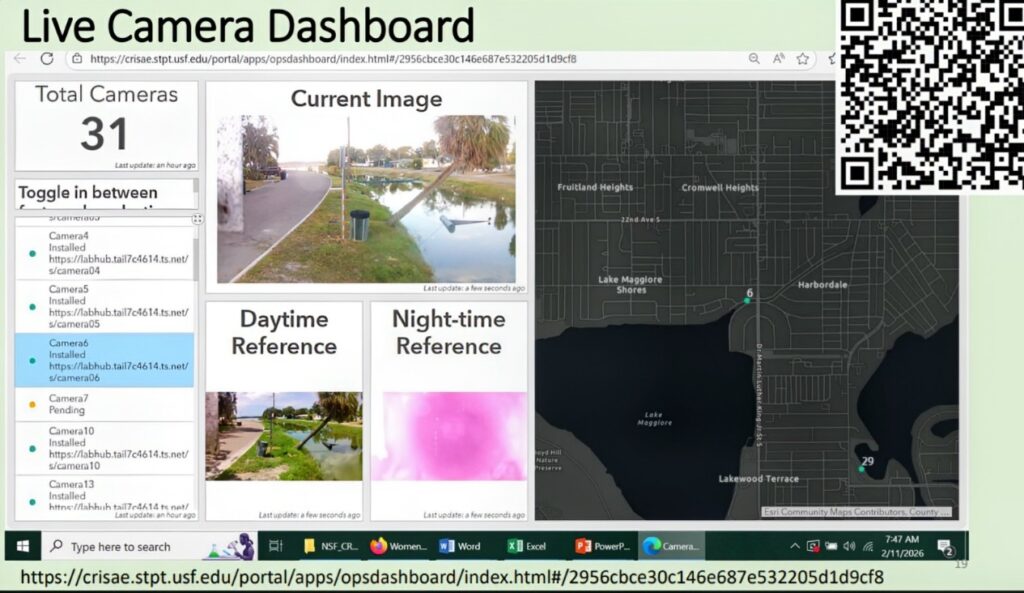
The app’s interface. Stakeholders hope to increase awareness of the evolving tool. Image: City documents.
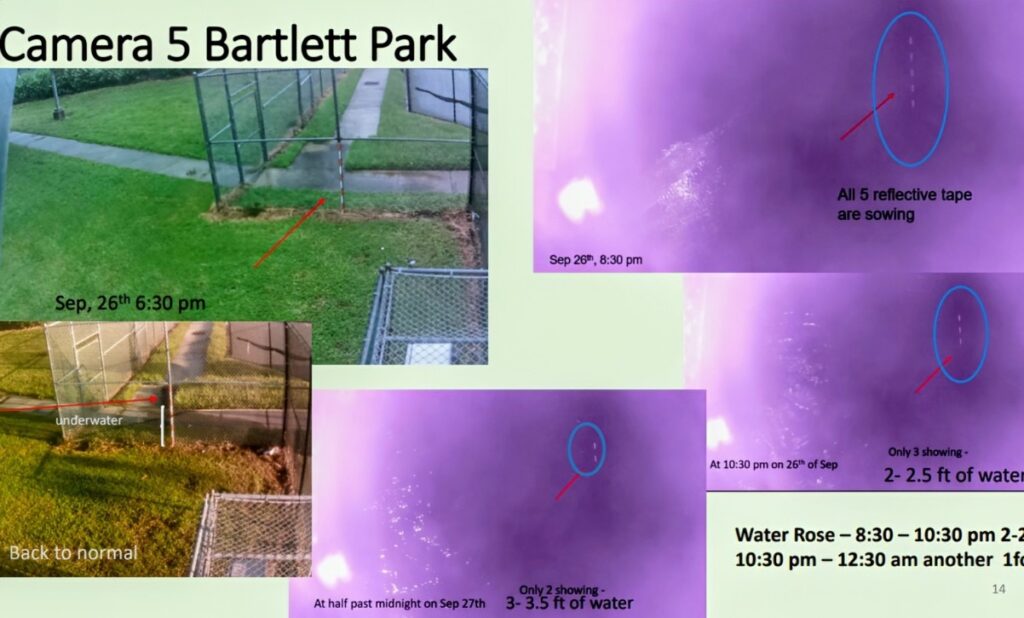
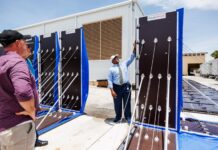
A reflective marker posted in front of cameras helps determine flooding levels. Image: City documents.
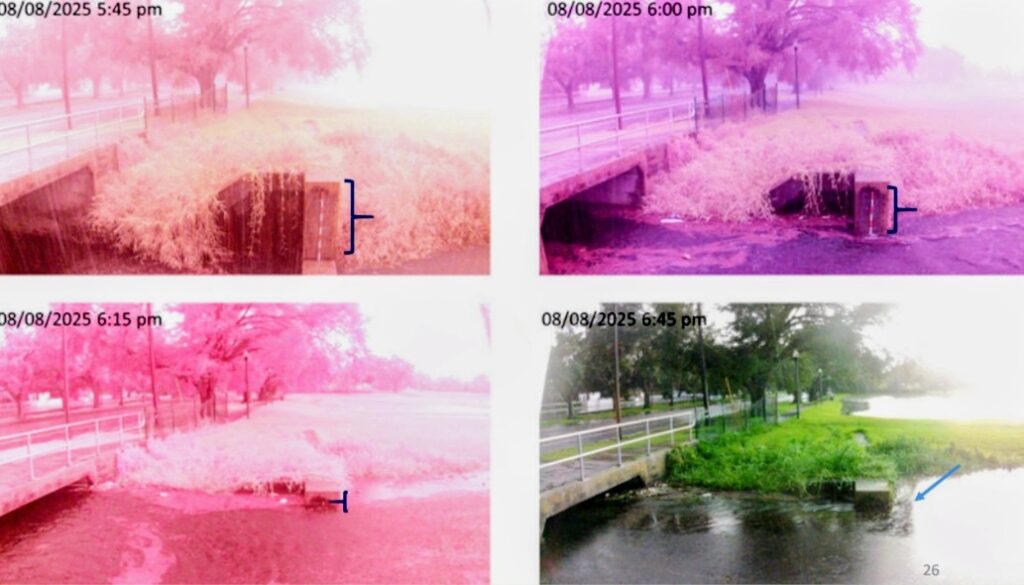
A bridge in west St. Petersburg during a historic rainstorm. The app helps drivers avoid flooded roads. Image: City documents.
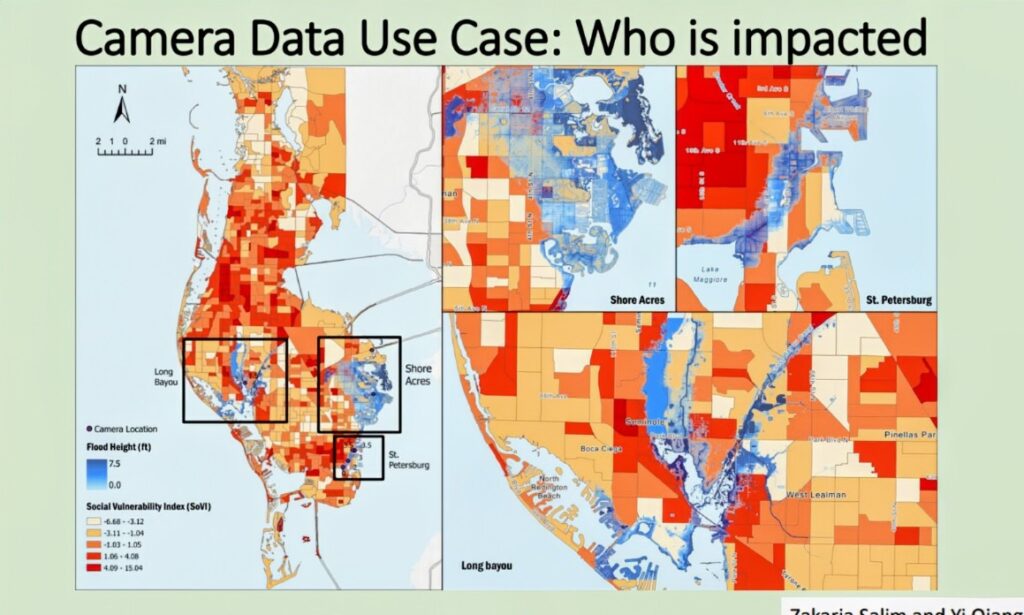
The platform incorporates a social vulnerability index. Image: City documents.