














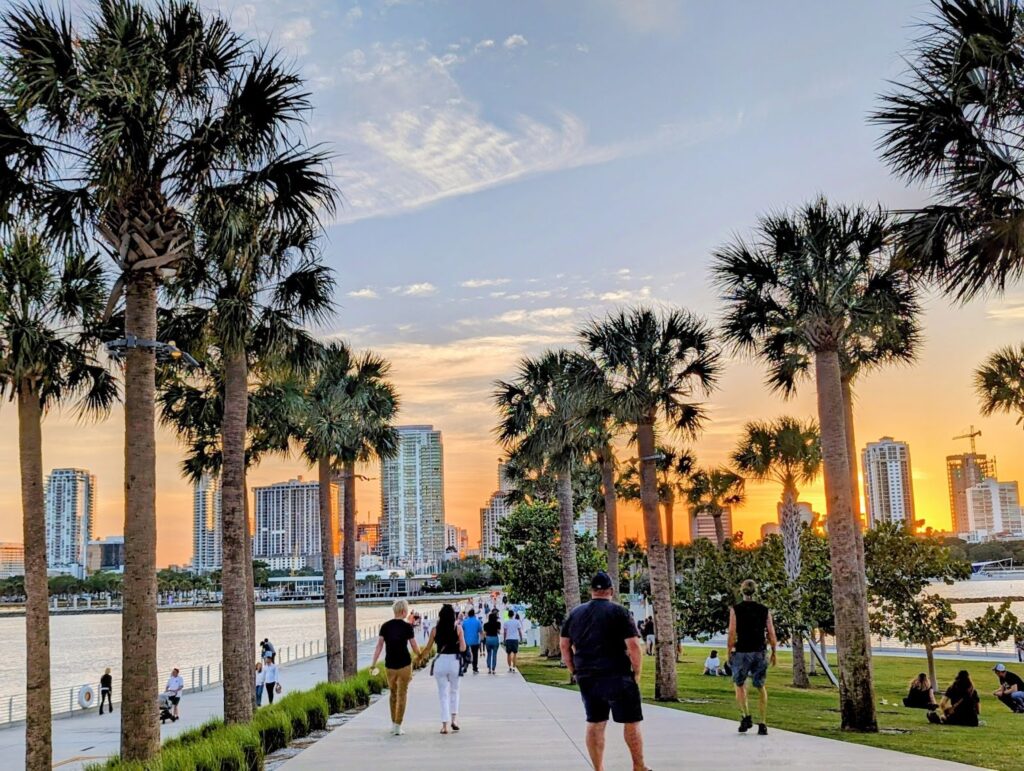
St. Petersburg plans to complete $361.25 million worth projects downtown before sunsetting the Intown Community Redevelopment Area, established in 1982 to reduce blight. Photo by Mark Parker.
St. Petersburg prolonged a community redevelopment area’s lifespan to support a new Tampa Bay Rays stadium and the Historic Gas Plant District’s rebirth. Officials are now reallocating those resources.
Mayor Ken Welch’s administration presented plans to “rollback” the Intown Community Redevelopment Area (CRA), by terminating it in 2032, at a city council committee meeting on Thursday. A 5-3 vote in June 2024 extended it a decade, through 2042, and increased its budget cap from an estimated $232.35 million to $574.85 million.
Councilmember Richie Floyd, who previously called the Intown CRA a “large subsidy for downtown,” has led efforts to unravel the extension since March 2025, when former Rays owner Stuart Sternberg walked away from a Gas Plant redevelopment deal. While his colleagues and the administration support the idea, the amount of money now dedicated to rejuvenating the St. Petersburg Municipal Marina was a point of contention Thursday morning.
The CRA shifts, if approved, would increase funding for downtown waterfront, transit, and parking improvements from $35 million to $145 million. Another $62 million would cover the first phase of a $165 million marina redevelopment project.
“I just find this, quite frankly, to be fiscally irresponsible,” said Councilmember Brandi Gabbard of the project’s price tag. “I’m afraid it’s going to be a boondoggle.”
Local governments establish CRAs to mitigate blight by diverting an area’s property tax increases to redevelopment and infrastructure projects. The money would otherwise go to general funds and help cover citywide expenses.
Established in 1982, the Intown CRA runs east from Tropicana Field to the St. Pete Pier. In 2005, the city extended the tax-increment financing (TIF) district through 2032.
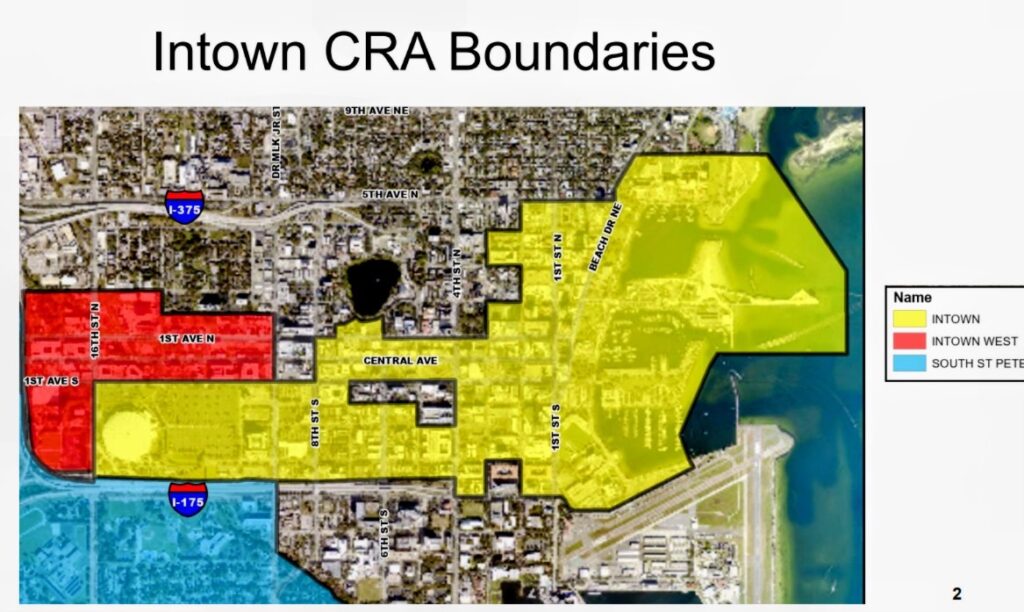
A map of the Intown Community Redevelopment Area, established 33 years before the much larger South St. Petersburg Community Redevelopment Area.
Officials amended the Intown CRA again in 2024 to include new funding categories for a Rays stadium and the Historic Gas Plant District. They planned to allocate $212.5 million and $130 million, respectively, to those projects.
Floyd believes the Intown CRA “locks tons of wealth” into a now-thriving area. “Just rolling it back to 2032 is already a compromise, because I have some real moral qualms with it existing anymore,” he said in October 2025.
The October meeting came days after Ark Ellison Horus submitted a $6.8 billion unsolicited bid for the Gas Plant, currently home to the Trop. The development team expects $239 million in infrastructure costs and TIF funding to help offset the bill.
Welch is currently considering other recently submitted proposals, and most incorporate Intown CRA funding. However, council members and administrators did not broach that topic on Thursday.
“This is obviously an important subject,” said City Administrator Rob Gerdes. “There’s a lot of opportunity here for the future of St. Petersburg, so it’s a good discussion to have.”
The administration wants to align funding with “current realities” and address “urgent infrastructure and resiliency needs,” said City Development Administrator James Corbett. An updated list highlights $361.25 million worth of downtown projects to complete by 2032.
Changes include increasing St. Pete Pier funding from $10 million to $15 million and dedicating $1 million, over half the cost, to a permanent Tampa Bay Ferry dock. Pinellas County will contribute $108.1 million to approved CRA projects.
The administration’s plan would also provide $6 million for park improvements and related infrastructure, $10 million for the Mahaffey Theater, $5 million for the Dali Museum, and $40 million for new seawalls around a long-proposed Center for the Arts.
Officials would reduce funding for historic property preservation from $5 million to $2.9 million. The city would maintain $75 million for redevelopment infrastructure, including improvements to the Pinellas Trail, Booker Creek, and the Trop’s demolition.
St. Petersburg and project partners could also apply for bed tax dollars, generated from a 6% surcharge on overnight stays, to offset costs for the marina, the ferry dock, the Mahaffey, and the Dail. Councilmember Copley Gerdes, who sits on the Tourist Development Council, said the city is “in a very good position” to receive those funds, “because of how conservative we’ve been” on capital project requests since the stadium deal fell through.
“I’m very much looking forward to moving on some of these projects in the next five years,” Gerdes added. “You’re going to see this massive investment inside of the CRA – you’re going to see that fast.”
Floyd noted that the municipally-owned marina is a revenue-generating asset, something that is “very important to me.” The facility has fallen into disrepair, and he and Gerdes believe the city lacks a better alternative than self-funding its revitalization after years of unsuccessfully attempting to secure a private partner.
Councilmember Gina Driscoll shared Gabbard’s concerns. She wanted to delay moving plans for the Intown CRA forward until after hearing a detailed report on the marina project.
While Floyd wants to sunset the TIF district “as quickly as possible,” he also recognized the need for “a little more hashing out.” Administrator Gerdes said he heard enough to discuss the plans with county commissioners.
“We’ll come back, we’ll talk about the marina, and we’ll see how that goes.”
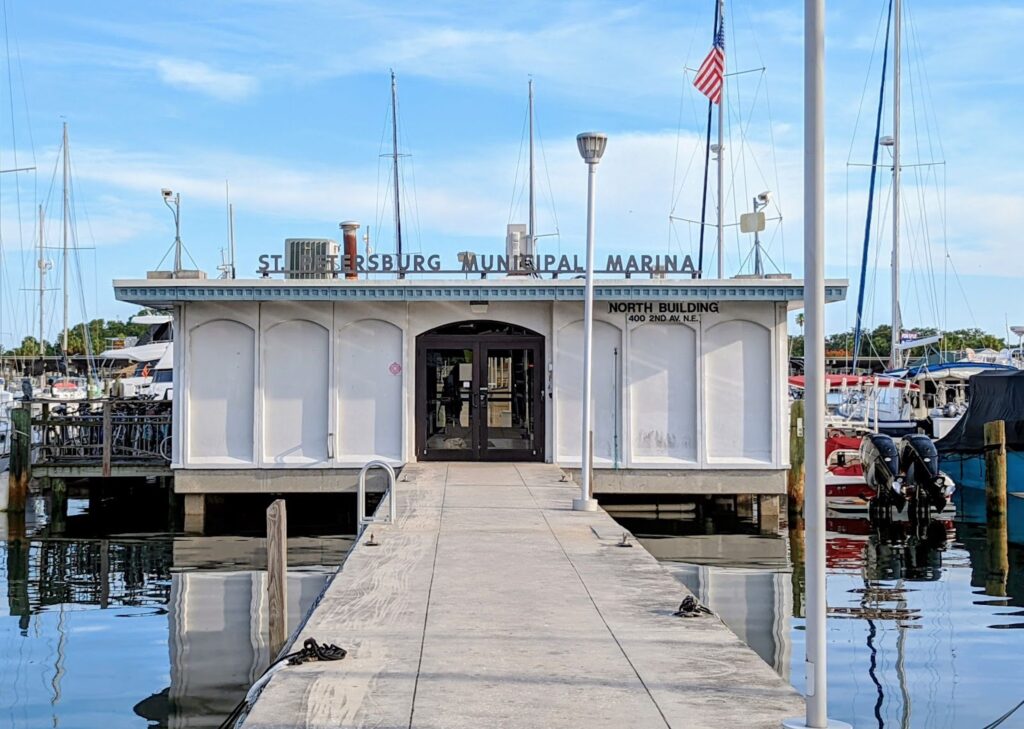
The budget for the St. Petersburg Municipal Marina’s redevelopment was $148 million in November 2025. The cost has increased to $165 million. Photo by Mark Parker.
Share Your News With Us
To share news with the Power Broker, email us at reachout@powerbrokermagazine.com. To sign up for our twice-weekly e-newsletter, visit www.powerbrokermagazine.com; and to join our online conversation, subscribe to our YouTube channel at Power Broker Media Group – YouTube.