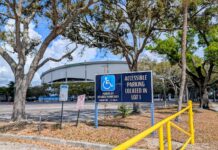
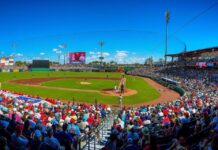








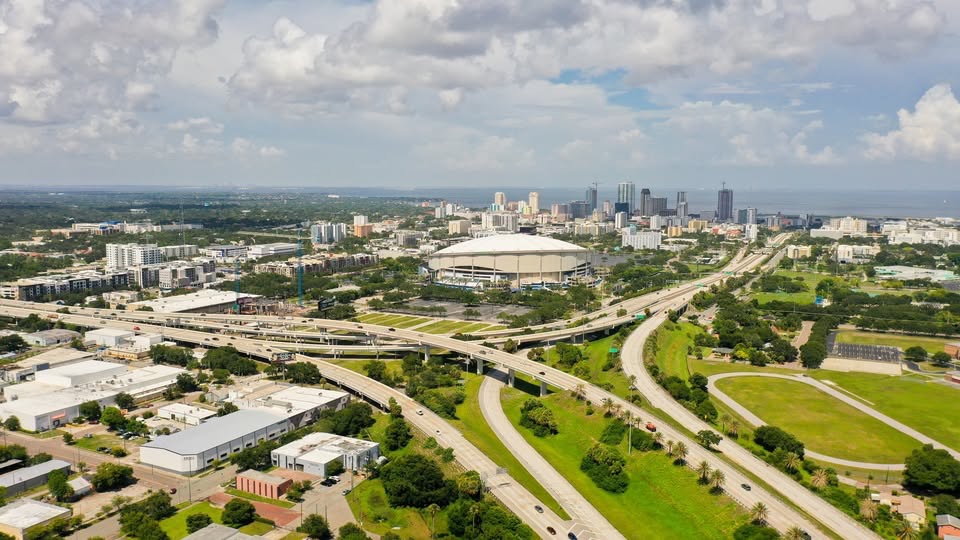
Two of eight proposals to redevelop the Historic Gas Plant District follow the same outline as a previous bid by the Tampa Bay Rays and Hines, which former team owner Stuart Sternberg walked away from in March 2025. Photo: City of St. Petersburg.
Mayor Ken Welch is currently considering eight proposals to reimagine the Historic Gas Plant District, currently home to Tropicana Field. His decision will alter St. Petersburg’s socioeconomic fabric.
The site, once a haven for the city’s African American community during segregation, is steeped in history and long-deferred promises. Hundreds of families and businesses were displaced in the name of economic progress; they received a baseball stadium and a sea of surface parking lots.
St. Petersburg’s first Black mayor has sought to make amends since taking office in 2021, and arduously negotiated a failed $6.7 billion redevelopment deal with the Tampa Bay Rays. However, his priorities for the 86-acre site remain unchanged – jobs, entrepreneurial opportunities, affordable housing, and a new home for the Woodson African American Museum of Florida.
“This project is about people, history, and long-standing promises – not simply a stadium site or a real estate transaction,” Welch wrote in a recent memo to city council members, who must ultimately approve a redevelopment deal.
Here are some key components of each proposal:
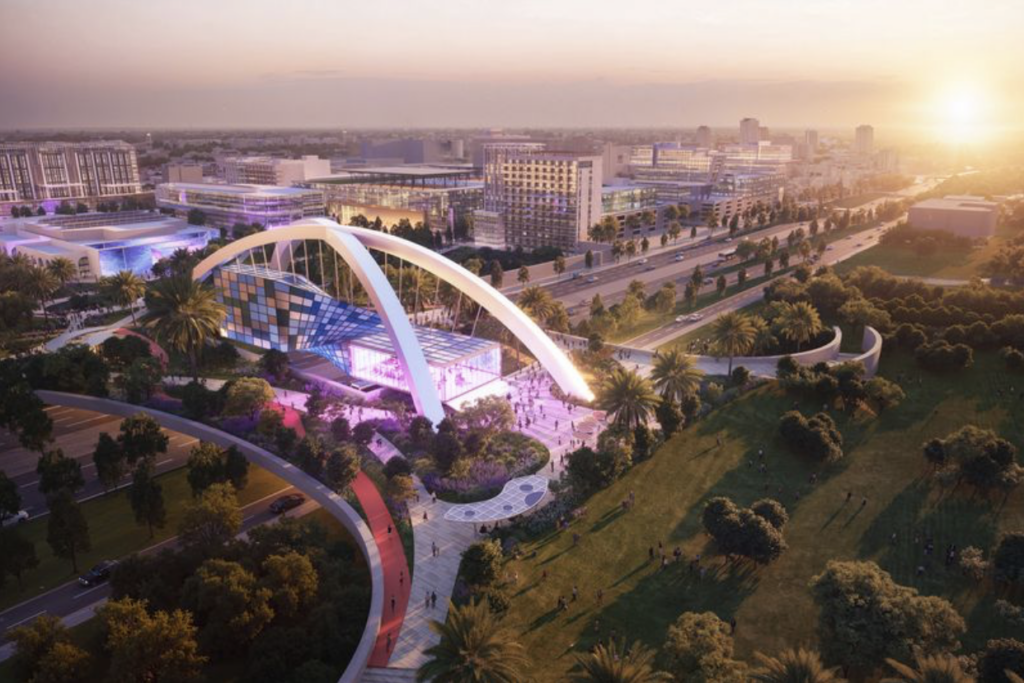
Ark Ellison Horus proposed an elevated park with a “Community Arch” that connects the Historic Gas Plant District and South St. Petersburg neighborhoods. Rendering provided.
Ark Ellison Horus
Ark Investment Management, Ellison Development, and Horus Construction submitted an unsolicited proposal in October 2025, which led Welch to launch the land disposition process. The development team’s $6.8 billion pitch encompasses four phases and 95.5 acres.
Ark Ellison Horus outlined a “restorative justice and reconciliation” plan with “community-first phasing.” If approved, the group will break ground on a new Woodson African American Museum of Florida, provide 446 affordable housing units with street-level retail space, enhance the 16th Street South corridor, launch a minority-focused business accelerator, and help reconnect neighborhoods within the first 1,000 days.
The proposal includes a total of 3,701 new homes, with 863 designated for people who earn between 30% and 80% of the area median income. Ark Ellison Horus will also build 618 affordable units for seniors.
The developers offered $202 million for the land, which includes $50 million in community benefits and demolition of the Trop. Ark Ellison Horus would also create a “Unity Arch” land bridge to Campbell Park, a 200,000-square-foot Innovation Hall, an 80,000-square-foot music venue, and expansive business incubation, academic, and research facilities before the project is completed in 2043.
Ark Ellison Horus set a small, local, and minority-owned business participation goal of 40%. The developers expect the 20-year, $6.8 billion project to create 14,296 “higher wage” jobs and 5,442 temporary positions.
Ground-penetrating radar has found 10 potential graves underneath the Trop’s parking lots. Ark Ellison Horus plans to create a “thoughtful memorial” to ensure those buried at the site are “acknowledged with dignity and respect, creating a lasting place of remembrance within the District.”
“The Gas Plant District can become a magnet for venture capital, entrepreneurs and research talent, seeding the next wave of world-changing companies right here,” said Cathie Wood, founder of ARK Invest, in a prepared statement.
“By embedding education, culture, and startup opportunities alongside housing and infrastructure, this vision can generate exponential long-term economic impact, create thousands of high-wage jobs, and ensure residents share directly in this prosperity.”
To view the proposal, visit the website here.
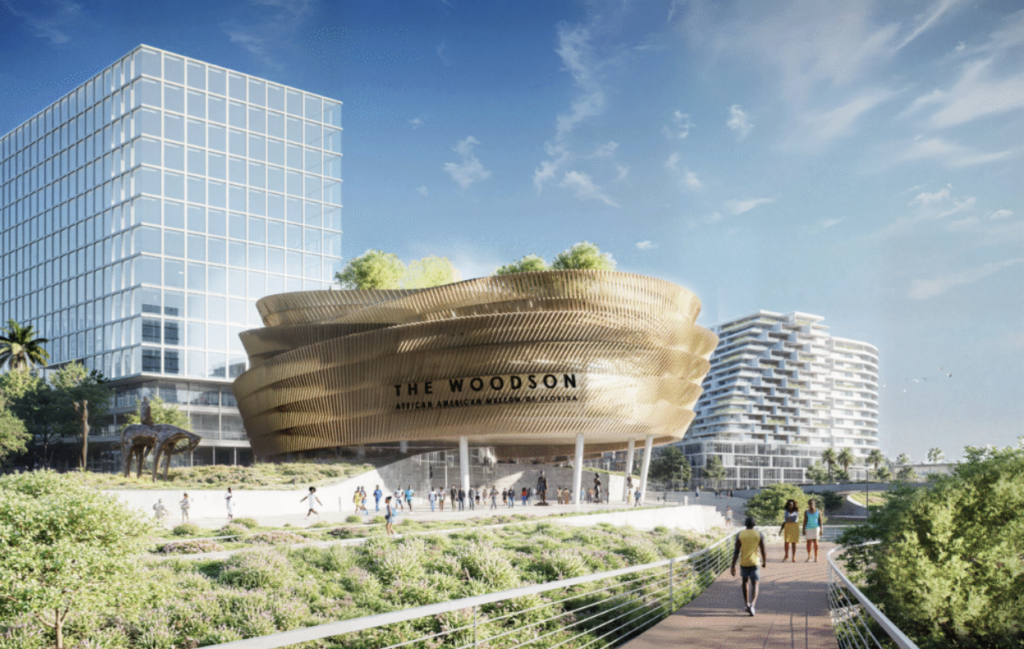
A new Woodson African American Museum of Florida will serve as the “crown jewel” of a “Museum Row” in The Burg Bid’s proposal. Rendering: Wannemacher Jensen Architects and Zyscovich (now Stratus).
Blake Investment Partners / The Burg Bid LLC
St. Petersburg native Thompson Whitney Blake, founder of Blake Investment Partners, has partnered with the Related Group, a Miami-based development firm, and several local organizations on his $8.1 billion proposal. A 13-acre central park and new Woodson Museum would anchor the reimagined district.
A “museum row” would also feature a public art museum led by local artists Chad Mize and Mark Aeling. The proposal includes the “largest delivery of affordable and workforce housing units in city history” – over 3,600 on and off-site units.
St. Petersburg-based Blue Sky Communities will help build 1,800 income-restricted units in the Gas Plant and another 1,800 throughout the city over approximately 15 years. The proposal also features conference facilities, academic and research buildings, childcare space, cultural venues, and “significant contiguous green space featuring Booker Creek and the Pinellas Trail.”
Community leaders representing over 20 organizations will serve on a permanent advisory committee, the Historic Gas Plant Visionary Panel. Participants will provide ongoing project guidance, feedback, and accountability.
The developers would purchase 58 acres for $275 million. Additional highlights include a small business success center, “The Collaboratorium,” and space for a potential water and surf park.
Studies on disparity and structural racism will inform efforts to provide “meaningful economic opportunities,” including jobs and business ownership, to historically underserved communities. A Community Investment Fund, a “wealth-generating special purpose vehicle,” will enable residents to have a financial stake in the generational project.
The proposal prioritizes reconnecting bifurcated South St. Pete neighborhoods through a multimodal transportation network, continuous workforce development with apprenticeship and placement programs, environmental sustainability, and innovation through smart city technologies.
“We’re weaving together housing, culture, and commerce, with meaningful community accountability to create everlasting value for the city,” Blake said in a prepared statement. “The Historic Gas Plant District holds deep meaning, and our vision represents a long-term commitment to the people of St. Petersburg.”
To view the proposal, visit the website here.
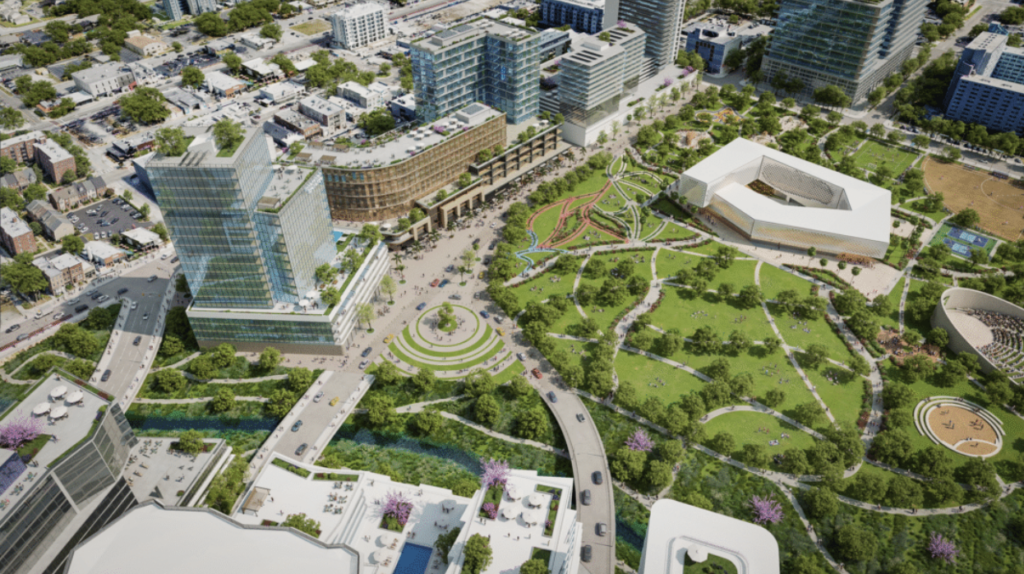
Foundation Vision Partners will prepare the site for “shovel-ready vertical development parcels” that the city would then sell, “block-by-block,” to local, regional, and national developers. Rendering provided.
Foundation Vision Partners
Former members of the Rays and Hines development team submitted a unique proposal that would allow St. Petersburg to retain ownership of the 86 acres surrounding Tropicana Field. Foundation Vision Partners (FVP) is led by Will Conroy, founder of St. Petersburg-based real estate investment firm Backstreets Capital; Alex Schapira, former regional partner for global developer Hines; and Anddrikk Frazier, CEO of Best Source Consulting.
The group would take a master planning and infrastructure-first approach to transforming the area into a vibrant, mixed-use community. FVP’s announcement stated that the Gas Plant, “a site of profound cultural and historical significance,” remains undeveloped due to “all-or-nothing” models.
FVP plans to co-create a master plan with the community before starting the project’s design, permitting, and essential infrastructure phase. That will prepare the area for “shovel-ready vertical development parcels” that the city would then sell, “block-by-block,” to local, regional, and national developers.
Under the proposal, St. Petersburg would pay an estimated $67 million in upfront infrastructure costs to unlock $510 million in land sales – creating a self-funding mechanism throughout the project’s lifespan. “A generational project deserves to be responsive to multiple generations,” Frazier said in a prepared statement.
“Our success will be measured by how effectively this district creates opportunity for residents and local businesses, and reflects the full fabric of St. Petersburg.”
The city would pay a total of $239 million over four development phases. FVP believes its model would foster approximately 4,700 mixed-income housing units, 825,000 square feet of office and medical space, 450,000 square feet of retail and restaurant space, 350,000 square feet of civic, cultural, and entertainment space, and over 20 acres of park and open space.
To view the proposal, visit the website here.
Freedom Communities Company
Sarellyn Hamatani, founder of Freedom Communities Company, submitted a six-page proposal encompassing 1 to 1.5 acres within the Gas Plant. The site would feature an affordable housing-focused mixed-use development, Sanctuary St. Pete.
The project’s first phase would feature 80 affordable and 20 workforce housing units. FCC would also build ground-level commercial space for a grocer and community amenities.
Future phases would include an unspecified number of apartments for seniors and additional workforce housing. The project, limited to one seven-story building, would offer a two-year rental-to-homeownership program.
Hamatani estimated the project’s costs at roughly $300,000 per unit. FCC also hopes to partner with Habitat for Humanity.
“This development is designed not only to house residents, but to restore opportunity, honor history, and build generational pathways to stability and ownership,” Hamatani wrote.
To view the proposal, visit the website here.
Logical Sites Inc.
Seminole resident Thomas Rask submitted a vague proposal on behalf of Logical Sites, Inc. & Partners. He wrote that the group could “only provide an outline of its plan for the site” due to legal concerns with the city’s solicitation process.
“In such an environment, putting exact plans, numbers, figures, and even the name of the development principal into the public record, at this point in time, would be extremely unwise,” Rask added.
The proposal’s “starting point is 100% affordable housing.” Rask, his wife, Jennifer, and unnamed partners will also create homes for residents with intellectual and physical disabilities.
Logical Sites believes its plan will allow the city to “exercise various options” that could include a Woodson Museum, a convention center, hotel rooms, and office, retail, and park space. However, those components would reduce the number of affordable housing units.
“If we are not selected, we anticipate that there will be a future and legally sufficient invitation for new proposals, an invitation which we will be happy to respond to more fully,” Rask wrote.
To view the proposal, visit the website here.
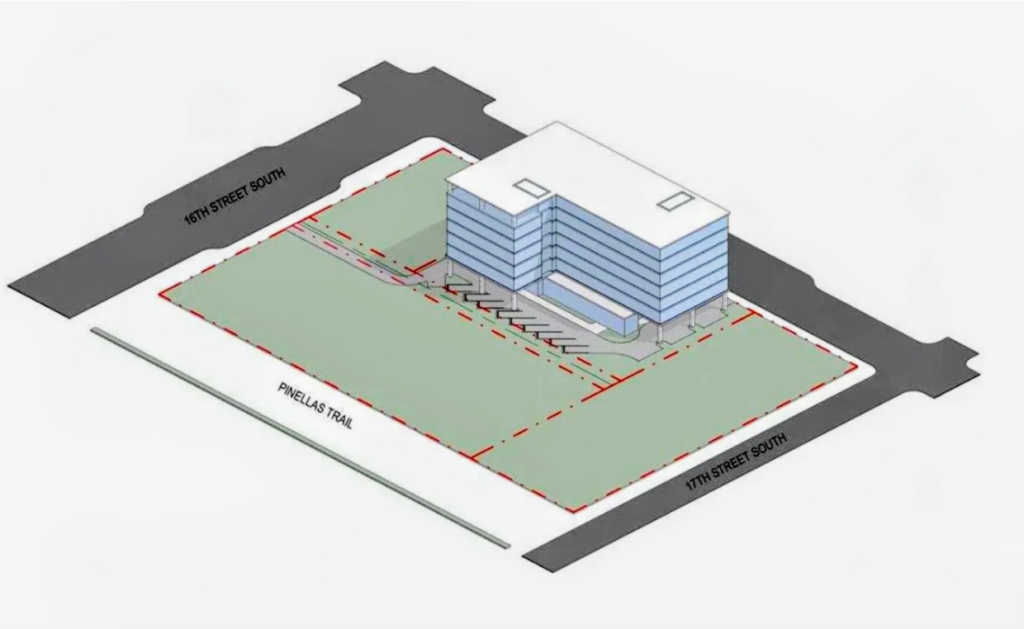
The Pinellas County Housing Authority proposed a seven-story affordable senior housing facility. Rendering: City documents.
Pinellas County Housing Authority
The Pinellas County Housing Authority (PCHA) submitted a proposal with Ascension Real Estate Partners and STORYN Studio for Architecture. It consists of a seven-story affordable senior housing facility at 1659 3rd Ave. S., a city-owned parcel used for overflow parking during Rays games.
The project would provide 80 affordable housing units, with SPHA prioritizing applications from former residents of the Gas Plant. Apartments would average approximately 700 square feet and cater to “lower-income seniors, with an emphasis on very-low income.”
The PCHA proposed a land conveyance fee of $1. The facility, designed by STORYN Studios, which was also part of the Rays and Hines development team, will feature ground-level and rooftop community spaces. It will also provide direct access to the Pinellas Trail.
Ark Ellison Horus selected the PCHA to oversee its affordable housing component. The St. Petersburg Housing Authority has signed non-exclusive letters of intent to partner with both The Burg Bid and Ark Ellison Horus.
To view the proposal, visit the website here.
Reparations Land Trust and Development Authority
The International People’s Democratic Uhuru Movement submitted a proposal for the Reparations Land Trust and Development Authority (RLTADA). It does not include a redevelopment or site plan.
Instead, the group plans to establish a quasi-governmental agency to secure reparations for displaced Black residents by seizing “large tracts of city-owned or corporate-owned land” in South St. Petersburg through eminent domain. The RLTADA would create a Community Empowerment Corridor between 1st Avenue and 54th Avenue South, from 49th Street to 3rd Street South.
The agency would then own, buy, sell, and develop land within those boundaries. A Black Contractor Consortium would complete the work.

Tampa Bay Boom’s proposal highlights new sports facilities, both inside and outside of the Gas Plant District. Rendering: City documents.
Tampa Bay Boom
Dr. R. Brian Ligon, a St. Petersburg-based dentist, proposed a mixed-use district with multiple sports-related projects. He plans to purchase the Gas Plant site for an unnamed amount.
Ligon also wants to purchase the Tampa Bay Rays and renovate or replace the Trop. Potential development partners include national firms HOK, Populous, AECOM, JE Dunn, and JLL.
The developers also hope to secure a new NBA franchise, the Tampa Bay Boom, a WNBA franchise dubbed the Tampa Bay Angels, and an NBA G League (developmental) team called the Tampa Bay Palms. Renderings include a 17,000-seat multipurpose arena adjacent to Al Lang Stadium along St. Petersburg’s downtown waterfront.
The proposal outlines an unknown number of affordable and workforce housing units. Ligon’s development model emphasizes “equitable public-private partnerships, minority and women-owned business participation, community-based workforce development, long-term ownership and stewardship, and financial sustainability with shared public benefit.”
Minority-led Tampa Bay Boom “anticipates engagement” with national financial institutions Bank of America, Goldman Sachs, and JP Morgan Chase to “strengthen financial capacity, enhance capital market credibility, and support disciplined execution consistent with the city’s expectations.” However, the proposal states that “no financial commitments are implied.”
In addition to a “substantial affordable and workforce housing component,” the project would feature retail and small business spaces, cultural, arts, and heritage-focused programming, workforce training, education and innovation spaces, public open space, green infrastructure, and community gathering areas.
“Our approach mirrors nationally recognized best practices for inclusive development, similar in structure and intent to precedent projects that integrate sports, housing, retail, culture, and workforce pathways into cohesive urban districts,” states the proposal.
To view the proposal, visit the website here.
Share Your News with Us
To share news with the Power Broker, connect with reachout@powerbrokermagazine.com. To sign up for our twice-weekly e-newsletter, visit www.powerbrokermagazine.com; and to join our online conversation, subscribe to our YouTube channel at Power Broker Media Group – YouTube.