

















While economists speculate about whether the U.S. will soon enter a recession, Black America may already be in the grips of one, based on the latest federal jobs reports, released in November and December.
Analysts are using the term “vibecession” to describe the mismatch between the widespread “feeling” that the economy is weakening, versus the hard data showing that employment and income are holding fairly steady, at least in the aggregate.
But drill below the national averages, and conditions are much different — and much worse — for African Americans. No other group has seen as much change in employment since Donald Trump was re-elected president last fall.
Though the absolute number of employed Black workers is up by about 1% since October 2024, that masks negative changes that signal not only hard times ahead for African Americans, but a possible reversal of positive trends occurring over the past decade.
1. Black Americans are the only group to see unemployment spike
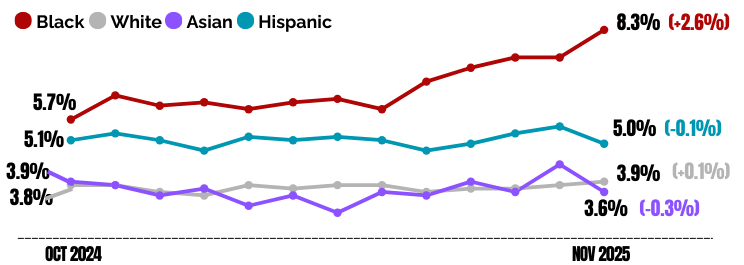
Black workers are the only racial and ethnic group to see their unemployment rate spike since Trump won the November 2024 election. The latest monthly jobs report shows Black unemployment nearly 1.5 times higher than it was before the 2024 election. The rate rose from 5.7% in October 2024 to 8.3% in November 2025 – a level not seen since the pandemic.
Meanwhile, unemployment has changed little for other groups. The rate rose by one-tenth of 1% for white Americans, and fell modestly for Asian workers (-0.3%) and Hispanics (-0.1%).
Figure 1: Unemployment Rate by Month (Oct 2024 – Nov 2025)
2. Black workers alone lost management & professional jobs
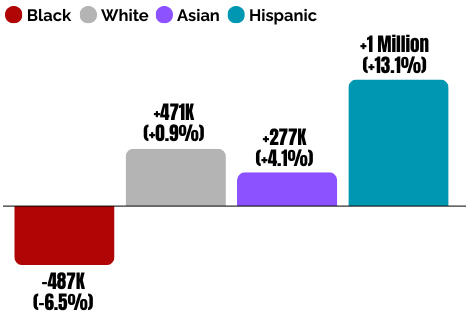
The past year saw dramatic changes in the types of jobs held by African Americans. The biggest change: from Q3 2024 to Q3 2025, the Black management and professional workforce shrank by nearly half a million workers (a loss of 6.5% of this cohort).
By sharp contrast, other racial and ethnic groups experienced growth in their management and professional workforce, ranging from 1% for white Americans to 13% for Hispanic Americans.
Figure 2: Change in Management & Professional Workforce by Race (Oct 2024 – Nov 2025)
Over the same time, the number of Black workers in service jobs grew by 3.5%; the number in sales and office jobs was up 7.9%; and the number of Black workers in construction and maintenance rose by 10.3%.
3. Black workers have seen double-digit losses in some occupations
If trends continue, the Black workforce could see critical mass-level losses in occupation groups where African Americans were already underrepresented.
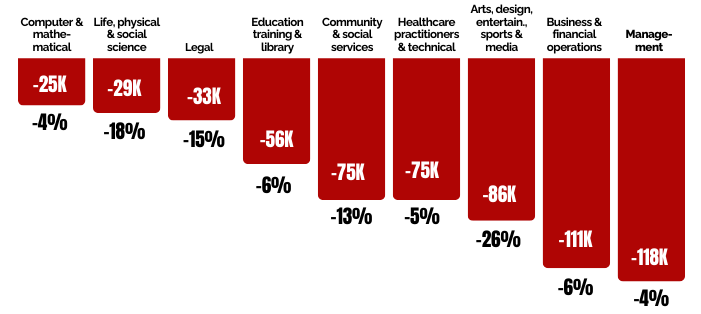
A drill down into subcategories of management and professional jobs shows several groups that lost one-tenth or more of their Black workforce over the past year. The most drastic case is arts, design, entertainment, sports, and media, which lost over one-quarter of its Black workforce (26%). The next biggest hit was in life, physical, and social sciences, where the Black workforce shrank by 18%, followed by legal occupations and community and social service jobs, which lost 15% and 13% of Black workers, respectively.
Figure 3: Change in Number of Black Workers in Management & Professional Subcategories (Oct 2024 – Nov 2025)
4. Black Americans were the only group whose full-time workforce shrank
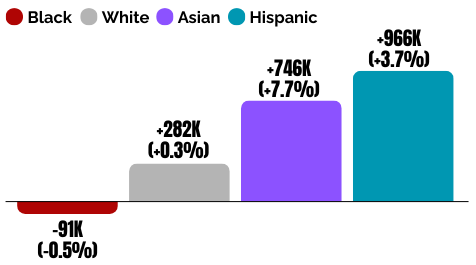
Other groups added full-time workers over the past year, while Black Americans had a loss in this cohort. From Q3 2024 to Q3 2025, the Black workforce lost about 91,000 of its full-time workers.
Figure 4: Change in Full-Time Workers (Oct 2024 – Nov 2025)
5. Black workers had the biggest increase in permanent job losses*
The data leave little doubt that Black job seekers are having a much harder time both finding and keeping jobs, relative to other groups.
From Q3 2024 to Q3 2025, African Americans had the largest increase in permanent job losses* (by far). This was both in absolute number and in the percentage of the unemployed who cite permanent job losses as the reason they are jobless.
Though Black Americans are only 13% of the nation’s labor force, the increase in their permanent job losses represents an incredible 64% of the national total (167,000 for African Americans and 261,000 for all Americans).
Figure 5: Change in Permanent Job Losses*(Oct 2024 – Nov 2025)
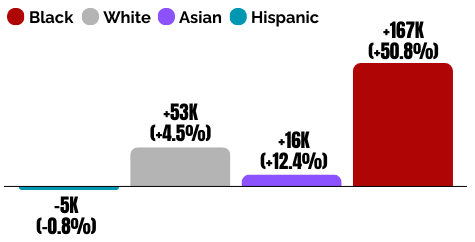
*Counting only unemployed workers who cite permanent job losses as the reason they are unemployed (U.S. Bureau of Labor Statistics Current Population Survey Table E-17. Unemployed people by reason for unemployment, race, and Hispanic or Latino ethnicity)
Summary Infographic
See our Infographic: 5 Big Changes in Black Employment Since Trump Was Re-Elected.
Connect & Share Your News
To share news with the Power Broker, reachout@powerbrokermagazine.com. To sign-up for our twice weekly e-newsletter visit www.powerbrokermagazine.com; and to join our online conversation, subscribe to our YouTube channel at Power Broker Media Group – YouTube.
Sources
This analysis used data released by the U.S. Bureau of Labor Statistics, including The Employment Situation (Monthly for October 2024 through November 2025, Tables A-2 and A-3) and Labor Force Statistics from the Current Population Survey (Quarterly for November 2025, Tables E-13 and E-17).