
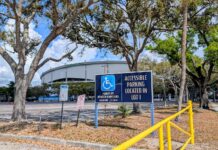
















The last project to trigger St. Petersburg’s community benefits process was the Historic Gas Plant District’s redevelopment. Photo: City of St. Petersburg.
Proposed revisions to St. Petersburg’s community benefits process, created to foster more equitable growth, have elicited concerns from city council members.
Standing members of the city’s Community Benefits Advisory Council (CBAC) suggested the changes after the previous two projects they reviewed failed to materialize. The discussion also precedes the Historic Gas Plant District’s impending redevelopment, which Mayor Ken Welch has said will again trigger the process.
Administrators presented several recommended changes to the CBA ordinance at a city council Economic and Workforce Development Committee meeting on Thursday, including changes to the way CBAC members are appointed, the number of CBAC members, the location and background of members, how projects are qualified as subject to the CBA ordinance, and developer reporting procedures.
“Some of the benefit changes that you’re proposing – I’m just not there,” said Councilmember Deborah Figgs-Sanders. “Because it’s taking away, for me, a lot of the community input.”
The history
St. Petersburg established its Community Benefits Program in 2021, under former Mayor Rick Kriseman’s administration, which collaborated with leaders of the New Deal, One Community Plan, Raise the Bar and other community groups to craft an ordinance unanimously approved by city council. Its overarching goal is to ensure that new developments receiving city subsidies provide positive socioeconomic impacts.
A project requesting public assistance – typically land – equal to 15% or more of the total construction cost, would trigger application of the ordinance. The Community Benefits Advisory Council (CBAC) helps determine what developers should provide to receive city approval.
Suggested developer requirements include contracting with small and minority-owned businesses, hiring apprentices and disadvantaged workers, providing affordable or workforce housing, promoting environmental resiliency and sustainability, and supporting public art, health, education, and technology initiatives.
The process has applied to just two projects. In 2022, Atlanta-based developer TPA Group offered $5 million for the 800 block in downtown St. Petersburg to build a 30-story residential tower with 350 market-rate apartments, a 14-story hotel, and a 75,000-square-foot Moffitt Cancer Center.
TPA planned to build 35 affordable and 35 workforce housing units in exchange for a $19 million discount on the land. The CBAC advanced the project. Welch, following unsuccessful negotiations with the developer to increase those numbers, nixed the deal.
A second, more monumental community benefits process ensued when the Tampa Bay Rays sought to redevelop the Historic Gas Plant District and build a new stadium to replace Tropicana Field. The CBAC signed off on that package, as well; however, former team owner Stuart Sternberg walked away from the generational project in March 2025.
“It’s not that the benefits agreement process did not work,” said Councilmember Brandi Gabbard. “It is that other circumstances called those deals not to go through. I just want to be very clear about that – and that is what gives me a lot of pause – because I’m not sold on what’s broken.”
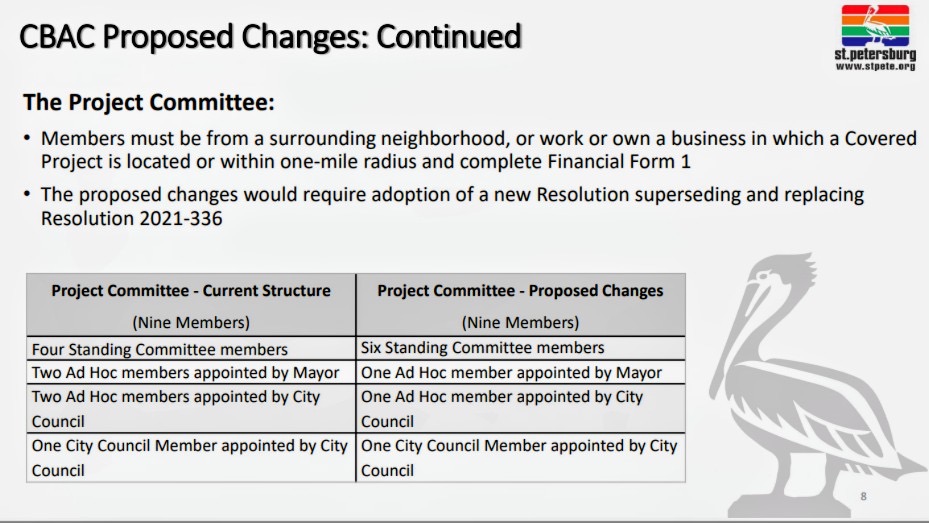
A graphic highlighting key proposed changes to the appointment process. Image: City documents.
The changes
If the proposed ordinance changes are approved, the number of standing CBAC members would increase from four to six, with the mayor and city council each appointing three; and the number of project-specific community members would be reduced from four to two. The new process would encourage but not require appointees representing all eight districts to have related professional expertise.
Figgs-Sanders said the benefits program was meant to align community advocates and professionals. She believes the city should prioritize residents who are “impacted the most” rather than those with experience in the housing, environmental resiliency, art, health, education, or technology industries.
“I kind of see an unintentional removal of some of our community advocates in this process,” Figgs-Sanders said. “If there’s something going on in South St. Pete, I think the majority of the feedback needs to come from South St. Pete.”
Another proposed ordinance change would allow the CBAC and community engagement to begin earlier in the process, once the city “reasonably anticipates” that the project will be subject to the CBA ordinance. Some advocates believe that will come at an unacceptable cost, as the administration also proposed eliminating a Community Impact Report.
Developers must currently submit a Community Impact Report summarizing their inclusion strategies and goals, which triggers the CBAC review process. Figgs-Sanders pushed back against the report’s elimination.
She also noted that the current program is “50% of what we asked for” in 2021, and the changes would further dilute the process. City staff clarified that eliminating the report would not weaken accountability. “We’re not removing any of the opportunities for public input,” said Andrea Falvey, economic and workforce development manager.
City Development Administrator James Corbett stressed that the changes were “simply” recommendations. He also explained that quashing the report would accelerate CBAC participation, and stakeholders would still receive proposed benefit information early in the process.
Councilmember Corey Givens, Jr. agreed with Figgs-Sanders. “If there’s a development that impacts South St. Pete, I don’t think we need more influence from neighborhoods outside of South St. Pete,” he said.
Givens also sought to ensure the “most impacted” areas have a seat at the CBAC table. He asked if the ordinance could legally enforce equal representation.
A city attorney said the council would ultimately decide the board’s makeup, and could request alternative ordinance language. “That is exactly what I’m looking for,” said Givens, who also supported increasing the number of standing CBAC members from four to six.
Gabbard noted she had “way too many concerns” to address in the abbreviated meeting. She said administrators “certainly haven’t answered” whether the revisions would foster additional opportunities for “more voices, or is it even more watered down?”
Members of the Economic and Workforce Development Committee agreed that the proposal warranted additional discussion. They voted to include the full city council at a Committee of the Whole meeting on March 12.
Councilmember Gina Driscoll credited standing CBAC members for providing the recommendations. “They know from doing the work what speed bumps they’ve encountered, and what could be made better,” she said.
“So, I do take these recommendations very seriously,” Driscoll added. “And although we may not ultimately adopt all the recommendations, we’re certainly going to give them the respect that they deserve.”
Share Your News with Us
To share news with the Power Broker, connect with reachout@powerbrokermagazine.com. To sign up for our twice-weekly e-newsletter, visit www.powerbrokermagazine.com; and to join our online conversation, subscribe to our YouTube channel at Power Broker Media Group – YouTube.