
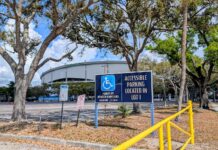












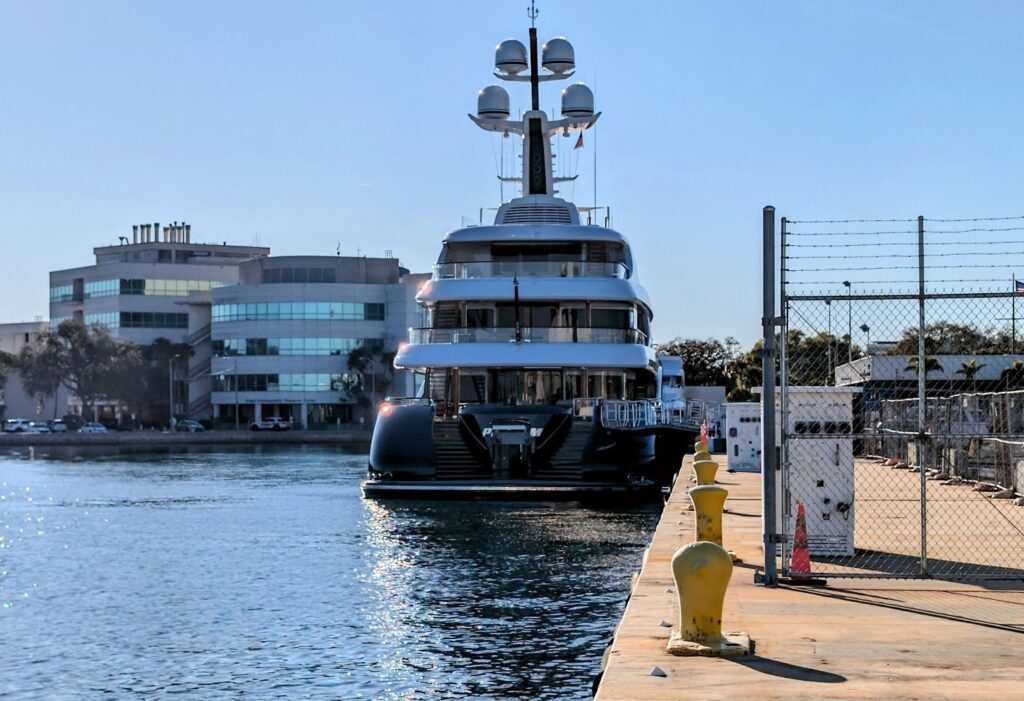
The Center for Coastal Resilience would replace an underutilized parking lot, which is temporarily housing a yacht, at Port St. Petersburg. USF’s College of Marine Science (background) has advocated for the facility. Photos by Mark Parker.
Long-discussed plans to expand on the Maritime and Defense Technology Hub’s success have received the first of three critical approvals. St. Petersburg voters will likely have the final word.
A city council committee enthusiastically agreed to ballot referendum language on Thursday that would allow 25-year leases at Port St. Petersburg. The city-owned facility’s underutilized surface parking lot, adjacent to the hub, could eventually house a Center for Coastal Resilience.
Previously known as Hub 2.0, the center would provide critical waterfront space for resiliency, research, and technology-focused government agencies, businesses, and academic institutions in St. Petersburg’s Innovation District, which would operate both facilities. The approximately $30 million project would not require city subsidies.
However, the city only permits 10-year leases at the port. Alison Barlow, CEO of the Innovation District, and vice president Jason Mathis, CEO of the St. Petersburg Downtown Partnership, previously requested a 50-year term.
A longer lease would help the two secure federal funding and raise private capital. Mathis said he and Barlow were “very supportive” of cutting their request in half.
“I don’t know anyone in the room that doesn’t like the 25-year idea,” Mathis added. “So, we’re very happy with that.”
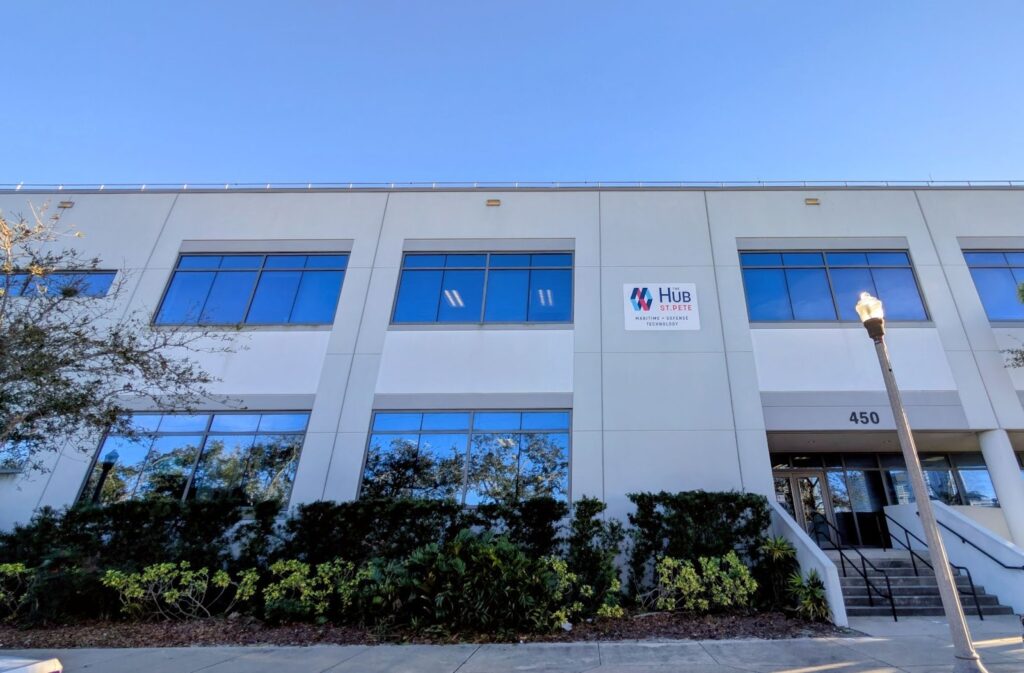
The city-owned Maritime and Defense Technology Hub is at 450 8th Ave. SE in St. Petersburg’s Innovation District.
Voters, following the full city council’s approval, will ultimately decide if the hub’s long-awaited sister facility comes to fruition. Public and private stakeholders agree that the 50,000-square-foot Center for Coastal Resilience would be a boon to St. Petersburg’s marine-based economy.
The Innovation District already boasts 1,900 marine science employees and an annual local economic contribution of $540 million. USF’s College of Marine Science anchors an industry cluster with over 30 private companies, research organizations, academic entities, and government agencies.
Barlow found immediate success when she opened the hub in January 2022. The 32,000-square-foot, at-capacity facility houses 20 tenants and supports 87 full-time and 132 secondary jobs.
On average, full-time employees at the hub earn $91,500 annually, Barlow said. In addition to attracting new businesses and organizations, the Center for Coastal Resilience would enable current tenants, including Saildrone and the state-sponsored Florida Flood Hub for Applied Research and Innovation, to expand operations.
Mathis noted that an independent consulting firm completed a feasibility study. The summation, he said, was that “there is indeed a great need for this.”
The study was a requirement to receive an estimated $16 million to $18 million in federal funding. Mathis also believes the Florida Ports Council, with the city’s sponsorship, will contribute between $10 million and $12 million to the project.
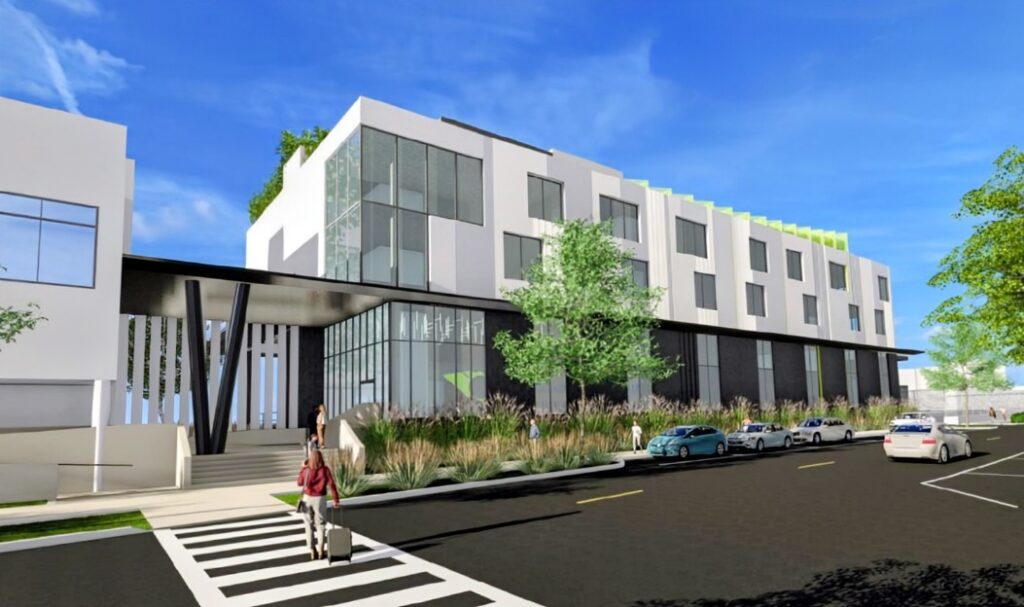
A rendering of the 50,000-square-foot Center for Coastal Resilience, which would connect to the Maritime and Defense Technology Hub (left). Image: City documents.
Pinellas County’s Employment Sites Program will likely offer $2 million or $3 million, Mathis said. “There should be very significant public sector support to help build this facility.”
“The facility will be successful,” Mathis pledged. “We believe it will be fully occupied, based on the experience of the existing Maritime and Defense Technology Hub and current office vacancies in downtown St. Pete.”
Barlow said the center would provide collaborative workspaces and a rooftop meeting area that could generate additional revenue and feature solar panels. She called waterfront access within a secure port the center’s “unique differentiator.”
The city council will now schedule two public hearings on an ordinance amendment that will facilitate a 25-year lease. If approved, the referendum would appear on ballots in November.
“It’s really exciting to me that we are at this point and moving forward with something that is going to really boost our profile in marine science and resilience,” said Councilmember Gina Driscoll, a longtime proponent. “And create a lot of jobs in the process.”
Share Your News with Us
To share news with the Power Broker, connect with reachout@powerbrokermagazine.com. To sign up for our twice-weekly e-newsletter, visit www.powerbrokermagazine.com; and to join our online conversation, subscribe to our YouTube channel at Power Broker Media Group – YouTube.
More Photos
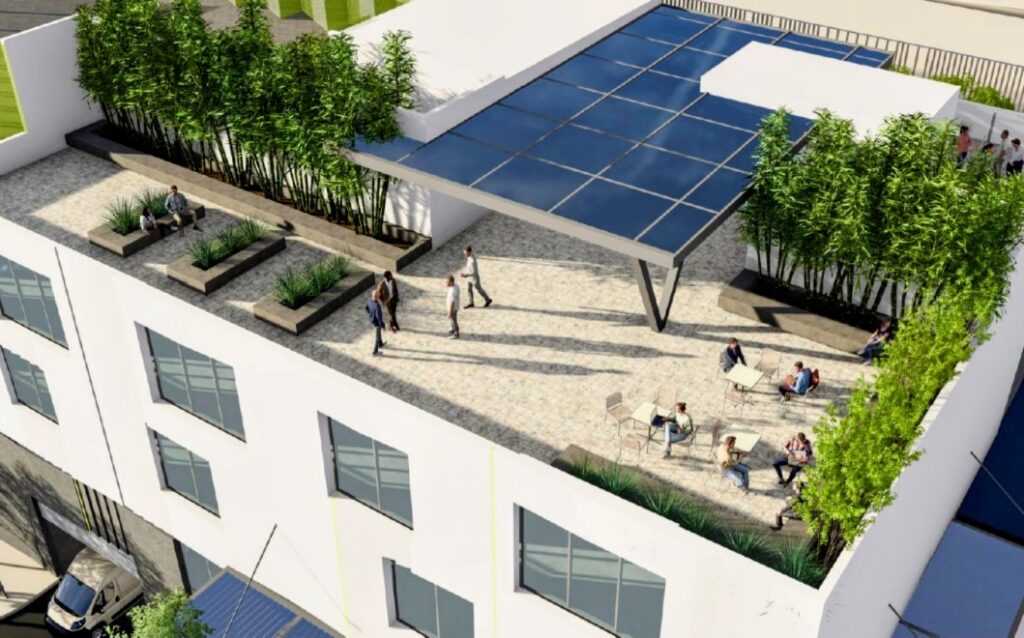
Renting rooftop space could generate additional revenue. Image: City documents.
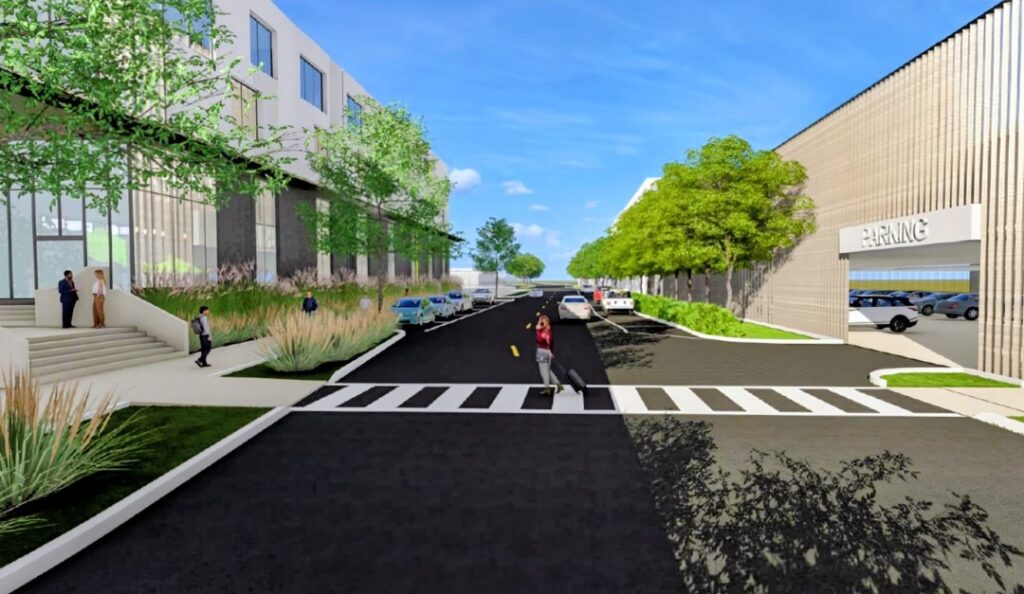
The Maritime and Defense Technology Hub and Center for Coastal Resilience would share a new parking garage with Albert Whitted Airport (right). Image: City documents.
Alison Barlow, CEO of the St. Petersburg Innovation District, said the new facility could feature a sphere created by the National Oceanic and Atmospheric Administration that uses “high-tech cameras” to display educational programming. Image: City documents.
An example of collaborative work spaces. Image: City documents.