













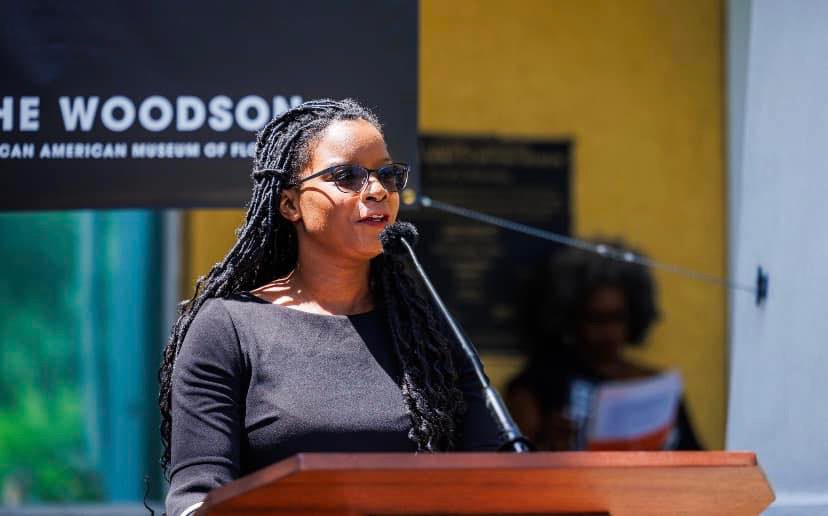
Pinellas County School Board Chair Caprice Edmond is also president of the Greater Florida Consortium of School Boards. Photo: Facebook.
Pinellas County school district officials continue grappling with declining enrollment, rising operational costs, funding changes, necessary closures, and political headwinds.
School Board Chair Caprice Edmond shared her thoughts on the district’s challenges and successes in a recent wide-ranging interview. She and her colleagues approved plans to close and consolidate multiple facilities on Feb. 24.
Edmond, also president of the Greater Florida Consortium of School Boards, noted that districts receive funding for each student. “If the enrollment declines, it’s just a logical conclusion that there’s going to be a financial challenge to maintain and manage the amount of property that we have – as well as pay the bills,” she said.
“We have to be aware of what we’re facing,” Edmond added. “The times have changed quite drastically.”
According to Pinellas County Schools (PCS) data, the number of enrolled students decreased by approximately 30,000 – from roughly 110,000 to 80,000 – between 2006 and 2024. Edmond offered several reasons for the decline.
Those include an expansion of charter school vouchers, which incentivize parents to pull students from public institutions, and the soaring cost of living in Pinellas. “Gentrification is happening, and people are being priced out,” Edmond said.
She also attributed shrinking enrollment to plunging birthrates and political issues. Edmond said some families “may be more fearful” of sending their children to school due to recent immigration enforcement efforts, although the district does not verify student citizenship.
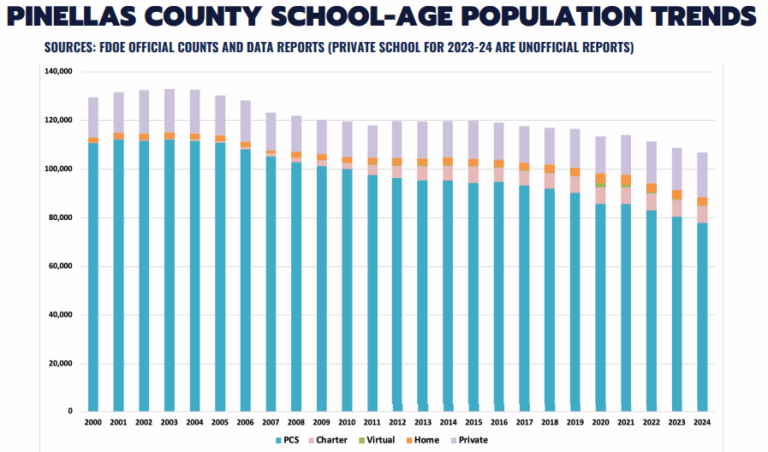
A graphic highlighting school enrollment in Pinellas County. Image: PCS.
Florida’s board of education voted to expand the so-called “Don’t Say Gay” law in 2023, which prohibits classroom instruction on gender identity and sexual orientation. “We had some families fear their child wouldn’t be supported, and decided to move out of state,” Edmond said.
She noted that a bill expanding upon Florida’s “harmful to minors” law is advancing through the Legislature and will “most likely impact school board policy.” Supporters believe the legislation would remove perceived obscene materials from libraries; opponents believe it will unnecessarily ban books with literary, artistic, political, or scientific value.
Edmond does not support the legislation and said political interference creates additional challenges for school districts. “Parental rights aren’t, in my opinion, parental rights for all,” she said.
“However, there are lots of great things happening in our schools,” Edmond continued, while mentioning Black History Month celebrations and recent state recognition. “There’s a lot of positivity outside of the political madness.”
PCS will close Pinellas Park’s Cross Bayou Elementary and Gulfport’s Disston Academy after the academic year ends in late May. The changes are part of the district’s multi-year Planning for Progress initiative.
Cross Bayou Elementary has received a “C” grade from the state since 2014, and needs over $5.1 million in capital improvements. PCS will reassign students to nearby schools, which, like the district, have earned “A” grades and recently received comprehensive renovations.
Disston Academy offers an Educational Alternative Services program that serves 52 on-campus students in grades six through 12. PCS will relocate students to alternative school sites in St. Petersburg, Largo, and Clearwater.
“You have to make these financial decisions that are both logical and student-focused,” Edmond said. “Students and teachers will have other opportunities at other schools.”
PCS will consolidate Bay Point Elementary and Bay Point Middle into a K-8 school on the latter institution’s South St. Petersburg campus in the fall of 2027. The district will also expand Oldsmar Elementary into a K-8 school beginning in the 2026-27 academic year.
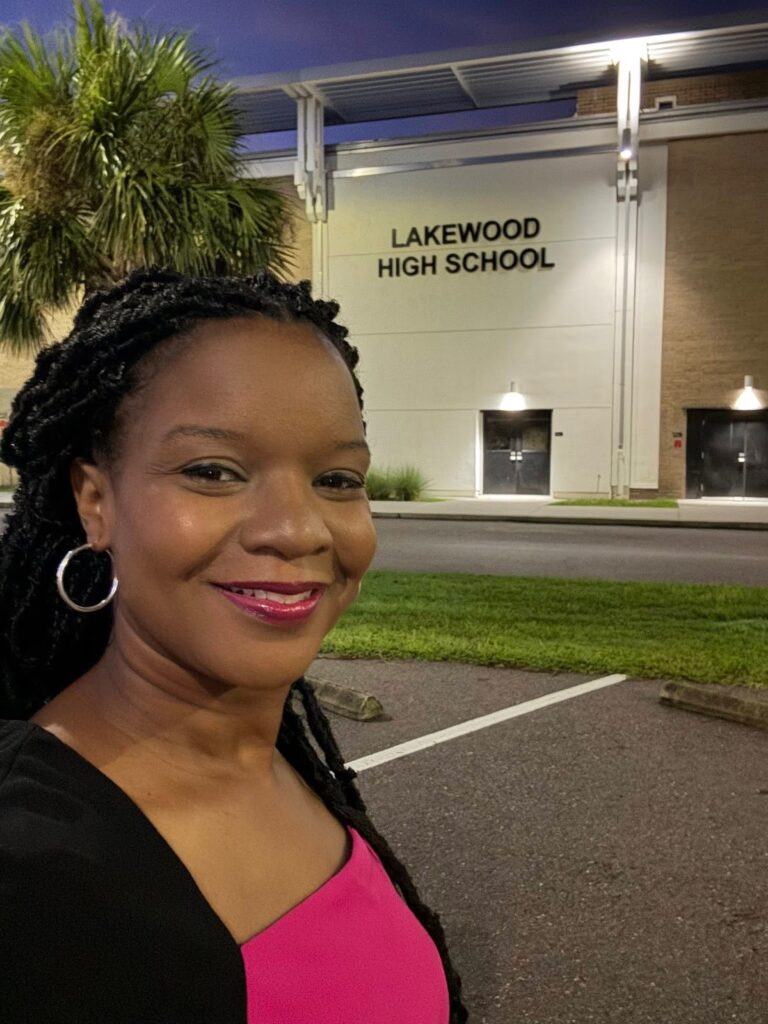
Lakewood High in South St. Petersburg is one of several local schools that have recently shown improvement. Photo: Facebook.
Edmond, whose District 7 encompasses South St. Petersburg, stressed that “all students deserve a high-quality education, regardless of their zip code, socioeconomic status, and race.” In August, Lakewood High School earned its first “B” grade in a decade.
The district as a whole received its second consecutive “A” grade, despite never reaching that benchmark until 2024. “We still have a long way to go, in my opinion,” Edmond said of closing persistent achievement gaps. “However, there are steps in place.”
She urges parents and guardians to share both positive and negative feedback with district officials. Edmond also noted that leading the Greater Florida Consortium of School Boards “provides an opportunity to amplify the advocacy that we’re doing legislatively for our district.”
The consortium represents 12 districts and 52% of Florida students. Edmond became the organization’s first African American president in 2024, and it has since approved a federal legislative program, established task forces for artificial intelligence and natural disasters, and implemented a youth committee.
“I had no idea this is what I would be doing when I ran for school board – no idea, couldn’t even imagine it,” said Edmond, who is up for reelection in November. “Now more than ever, it is important to have somebody who is going to advocate. Someone who is getting in the weeds and standing up for what’s right.”
Share Your News with Us
To share news with the Power Broker, connect with reachout@powerbrokermagazine.com. To sign up for our twice-weekly e-newsletter, visit www.powerbrokermagazine.com; and to join our online conversation, subscribe to our YouTube channel at Power Broker Media Group – YouTube.