
















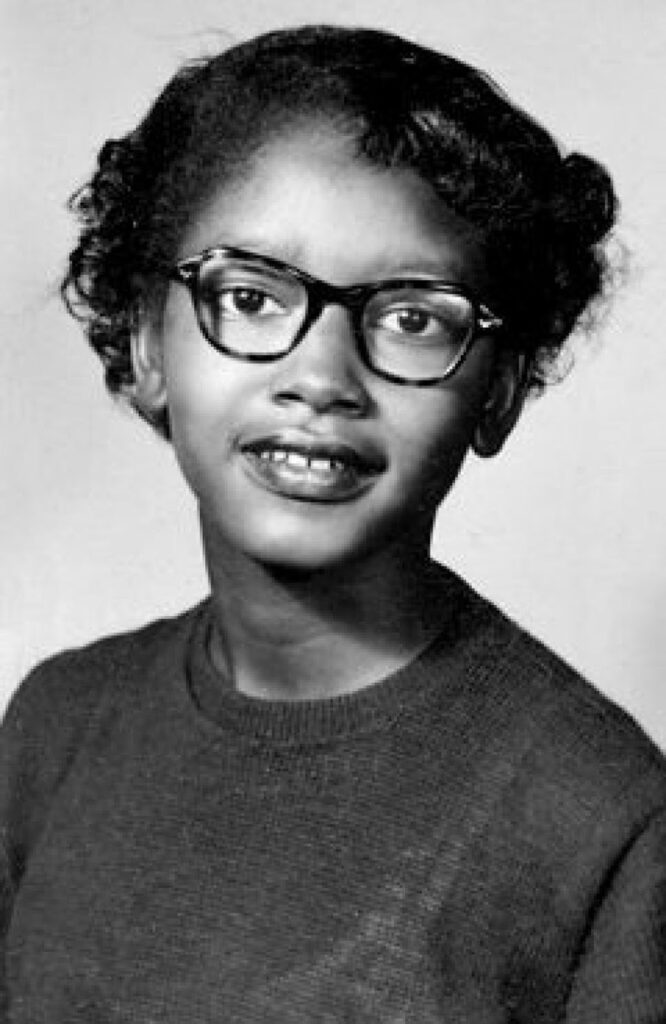
Photo credit Wikimedia Commons: Claudette Colvin as a teenager.
Months before Rosa Parks’ arrest, on March 2, 1955, a 15-year-old Claudette Colvin was handcuffed and jailed for her refusal to give up her seat to a white passenger.
Colvin rode home from school when the bus driver demanded that she and three fellow Black students give up their seats to a white lady. Colvin sat in the segregated section and refused to move. Later in life, she stated that, “It felt like Sojourner Truth was on one side pushing me down, and Harriet Tubman was on the other side of me pushing me down. I couldn’t get up.” (HISTORY.com Editors, 2016).
Though Montgomery’s segregation laws demanded that Black passengers sit behind white passengers, it was an unspoken rule for bus drivers to force Black riders to give up their seats for white passengers.
Colvin was handcuffed and arrested by two police officers who put her in a local adult jail.
“It’s my constitutional right to sit here as much as that lady. I paid my fare, it’s my constitutional right,” said Colvin. (Biography.Com Editors and Tyler Piccotti, 2026)
Colvin was charged with violating segregation law, disorderly conduct, and assaulting a police officer.
In 1956, Montgomery lawyer and activist Fred D. Gray represented Colvin and three other Black women plaintiffs in the Browder v. Gayle case. Gray, joined by Charles D. Langford, challenged Montgomery’s bus system as unconstitutional and filed a lawsuit on behalf of the four women. The case went all the way to the U.S. Supreme Court, which upheld the ruling that bus segregation violated the 14th Amendment.
This historically momentous case was followed by the Montgomery Bus Boycott, sparked by Parks’ arrest.
Although both Colvin and Parks shared similar historical origins, Parks was ultimately chosen as the face of the revolution because of Colvin’s background.
Colvin’s teen pregnancy, age, and color were all factors that the NAACP considered when they briefly thought of choosing her to challenge segregation laws. In the end, they believed those factors would negatively impact the public battle and decisively chose Parks to take the helm of the movement.
Colvin moved to New York two years later due to the hardships she endured. She ultimately dropped out of college and struggled to keep a job due to the negative publicity she received from the court case.
She later found work as a nurse’s aide at a Manhattan nursing home and retired in 2004.
Colvin died of natural causes on January 13, 2026, at the age of 86.
Yet, before she passed, Colvin was celebrated. She has received multiple recognitions and awards. A notable achievement was the expungement of her juvenile court record, for which she filed a petition in court in October 2021.
Colvin’s legacy continues to be shared, and she lives on in memory as a U.S. civil rights icon.
“I knew then, and I know now that, when it comes to justice, there is no easy way to get it. You can’t sugarcoat it. You have to take a stand and say, ‘This is not right.’” – Claudette Colvin
Share Your Story with Us
To share news with the Power Broker, connect with reachout@powerbrokermagazine.com. To sign up for our twice-weekly e-newsletter, visit www.powerbrokermagazine.com; and to join our online conversation, subscribe to our YouTube channel at Power Broker Media Group – YouTube.
Citation Information:
- HISTORY.com Editors. “15-Year-Old Claudette Colvin Refuses to Give up Her Seat.” History.Com, A&E Television Networks, 14 Jan. 2026, www.history.com/this-day-in-history/march-2/claudette-colvin-refuses-to-give-up-her-seat.
- Biography.Com Editors, and Tyler Piccotti. “How Claudette Colvin Played a Pivotal, yet Often Overlooked, Role in the Civil Rights Movement.” Https://Www.Biography.Com, www.biography.com/activists/claudette-colvin. Accessed 19 Jan. 2026. Updated: Jan 15, 2026 2:44 PM EST
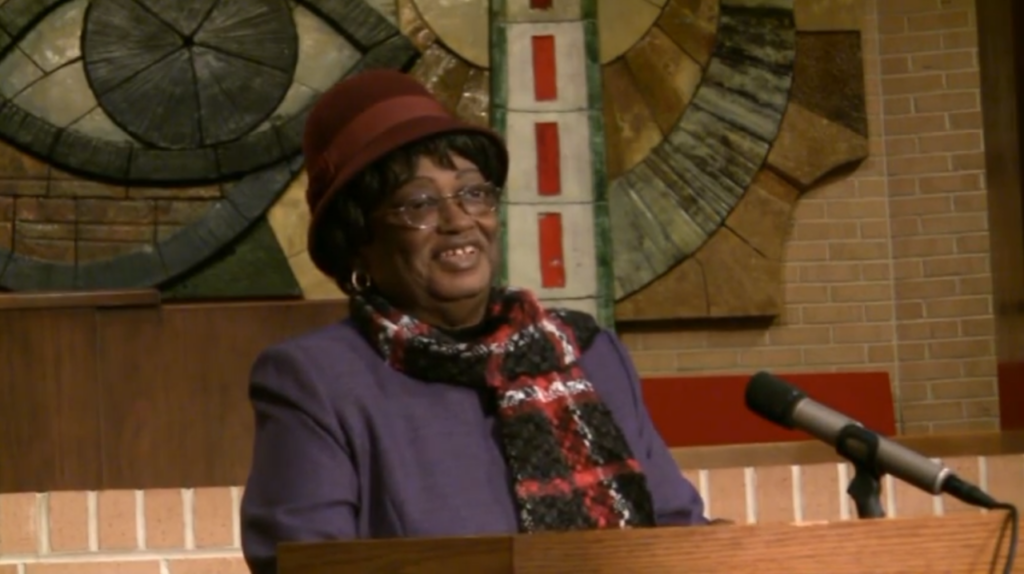
Photo credit Wikimedia Commons: Claudette Colvin speaking at a Women’s History Month event in 2014.